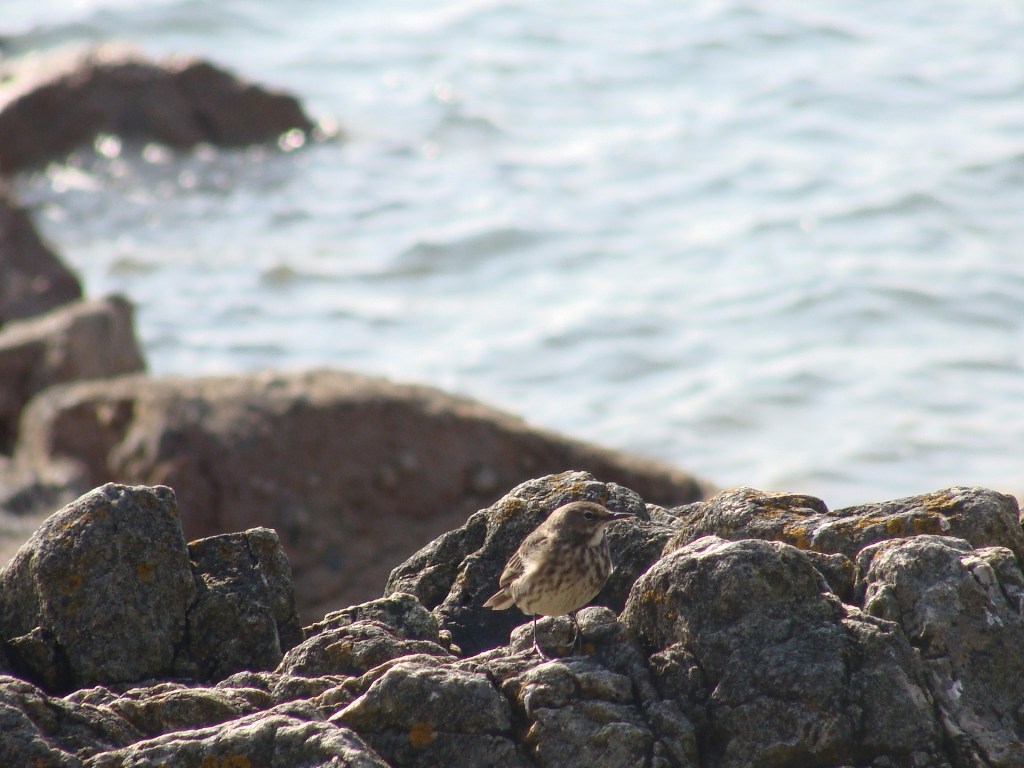
Cooling Marshes, Kent, 7th December 2014

Sunday, 1 May 2011

Breaking Dawn

Getting up at 3am to go wandering around a dark, mazy woodland is probably not a lot of people's idea of fun, but that's how I chose to see in this morning. 
Today is International Dawn Chorus Day and to celebrate this I lead a walk at Sydenham Hill Wood, organised by Ashley, the Warden. It was a great turn out for such an early start and the birds didn't let us down. Over an hour and a half between 0445 and 0615 we recorded 15 species, which in loose chronological order were:
Robin, Blackbird, Wren, Great Tit, Blackcap, Chiffchaff, Woodpigeon, Blue Tit, Song Thrush, Goldcrest, Carrion Crow, Jay*, Ring-necked Parakeet, Great Spotted Woodpecker*, Kestrel*
(*birds we saw but didn't hear)
The dawn chorus, the period as night passes and birds seek to re-establish breeding territories and advertise their presence, is easy to miss in a city like London but undoubtedly one of nature's little treasures.
“...let him betake himself one fine May morning to some green wood with plenty of undergrowth, where the migrant warblers consort and view in harmonies with our resident British songsters. There let him sit and listen, listen till, after their midday feed, the birds’ silent hour brings a temporary interval in the concert. Let him listen again when they resume in fuller voice after refreshment. Listen till dusk rings down the curtain and all but one Great Voice are still.
...let our critic do all these things and drink in the unrehearsed and unscored melodies. Then let him return to ‘civilization’ and tune in his radio set to some ragtime production intended to retail delectation to jaded city dwellers. He may then ask his heart the question, Where does true music dwell – in modish man-made cacophonies or in the ageless cadences of British songbirds?”
(from 'Bird Music' by A.L Turnbull, Faber and Faber, 1953) 

Wednesday, 27 April 2011

Red Tape Challenge

So the 'Red Tape Challenge', they just don't quit do they?!

And to think last May I walked out of a polling booth feeling pretty excited and hopeful that the Liberal Democrats were finally starting to punch their weight against the political monopoly. At the very least I thought they might provide a conscience to counter-balance Cameron but anyway, another week and another coalition attack on the environment and, let's face it, common sense.

The article linked above details the Government's decision to put over 21,000 regulations up for possible repeal, including all 278 of Britain's environmental laws. This includes mainstays of environmental policy such as the Wildlife and Countryside Act and the Climate Change Act. The idea is to have the public look at which regulations (or 'red tape') hinder business in the UK.

That the government is taking such a strong view on business growth is not surprising and not entirely unwelcome; a stable economy is important after all (and benefits the environment). But to prioritise the needs of business over the environment strikes me as being not only foolhardy, but yet another example of the short-sighted approach to planning and legislation which blights the UK. Presenting it as a 'Red Tape Challenge' makes light of a serious situation, it sounds like bloody 'X-Factor' or something!

To see National Parks, marine reserves and other important areas lose their legal protection would have potentially catastrophic results for the wildlife they support. These sites are all part of an essential system that underpins everything we do, from the air we breathe to the food we eat. Interestingly, as the article points out, issues of national security are exempt from the review, yet climate change legislation isn't (how many reminders do they need?) Our wild landscapes and the diverse range of species that inhabit them should be a source of pride and enjoyment not a political chip to be gambled with.

Should we be thankful that we've been given the opportunity to have a say on these matters? It feels like a gutless, cunning move, but I suppose we should be. Perhaps there is even a chance that some good can come from it. Maybe there are needlessly complicated laws that can be done way with, increasing efficiency and making way for progressive new thinking. Who knows? The passionate public response to the recent forestry debacle can also provide encouragement. A similar groundswell of support is needed again*.

Read the Red Tape website for all the details. Read this inciteful piece on Damian Carrington's blog and get inspired.

Updated 28/4/11
*Encouraging news from DEFRA and the RSPB Campaign against cuts; apparently over 11,000 people have already emailed Secretary of State for Business, Vince Cable! It's not over though. More here.

Sunday, 24 April 2011

Photoblog: Spring Special

Nuthatch (Sitta europaea), Dulwich Park 13/4/11
Adult Grey Heron with young, Crystal Palace Park 11/4/11
Little Ringed Plover (Charadrius dubius), East India Dock Basin 16/4/11
Female Chaffinch with nesting material, Sydenham Hill Wood 20/4/11
Fruits of a Small-leaved Elm (Ulmus minor), West Wood, Essex
Holly Blue (Celastrina argiolus), small, pale blue butterfly
with dark spots on underside of wing. Dulwich Park, 13/4/11

Monday, 18 April 2011

White Paper test for 'Greenest Government ever'

Working together: Bees on Field Scabious. PB

Back in October I gave a brief mention to the Government’s Environment White Paper which is due to be published this May. Since the time when we find out what exactly the government as a whole intends to do about protecting wildlife and stopping biodiversity loss in the UK is nearly upon us, the RSPB has launched a campaign reminding everyone that we can play a part too.
The Natural Environment White Paper (NEWP) represents a great opportunity to unite all government departments and promote a clear, common goal for nature conservation. However as part of the process, prior to a final draft being submitted, each department is entitled to review it and suggest changes. This means there is a possibility that important targets may be reduced (presumably as teams work out budgets, timetables etc).
One way of ensuring momentum for a strong paper is not lost is with something called an Early Day Motion (EDM), or a petition sent to parliament which calls for certain issues to be observed. With regards the Natural Environment White Paper an EDM (1601) has already been tabled which basically asks the government to back up its claim of being “the greenest Government ever" and deliver a convincing, effective plan. The RSPB suggests writing to your local MP and asking them to sign EDM 1601, it sounds like a good idea to me.

2010 was designated as the 'Year of Biodiversity' but that will count for little in the future without reliable, committed leadership now to ensure that we not only meet targets but strive to improve on them too. The NEWP is a big part of that. 

Why not write and tell your MP why you think nature is important? Or what concerns you have? If you’re not sure who you’re MP is, check here.

Friday, 15 April 2011

Ireland Birding - pt.2


After a few memorable days on the Beara Peninsular at the end of March, I swapped Gannets for geese as I travelled up to the pleasant coastal village of Portmarnock (just north of Dublin) to visit family. As an added bonus, Portmarnock is surrounded by some superb esturine habitats and the area happens to be home every year to a large gathering of Brent Geese (Branta bernicla). These geese occur in two main ‘races’ (or sub-species) and both are widespread winter migrants to British Isles.
Portmarnock  is significant however because it is an internationally important wintering ground for the scarcer Greenlandic pale-bellied race (Branta bernicla hrota) of Brent Geese which breed in northern Canada and migrate to the UK via Iceland. This area of Ireland holds the majority of their population (quite small, estimated at 40,000 birds) with only small flocks found elsewhere in Ireland and northern Scotland. The dark-bellied race (Branta bernicla bernicla) which occurs in England during the winter (and which I saw on the coast of Essex in February) breed in northern Russia/Siberia hence why they are found in large numbers on our east coasts. Within minutes of leaving Portmarnock station I encounter these birds at close quarters, feeding on the short grass of the floodplain. As geese go they are smaller and more reserved than Canada Geese and although the difference between the dark-bellied race is subtle it's nice to have been able to view the two races just a month or two apart.
pale-bellied Brent Geese grazing, Portmarnock, Co Dublin, 24/3/11
Brent Geese in flight
The birding wasn't confined to geese though and my Aunt was kind enough to tip me off about the nearby, picturesque Howth peninsular which is home every year to 5 species of Tern (including the rare Roseate Tern) Terns are great birds to watch and with spring underway I headed for Howth with hopes of catching some early migrants.
Unfortunately, despite a good look, I couldn't find any Terns this time (a touch early perhaps or the sandy/shingle beaches they prefer were beyond my reach) but I didn't come away disappointed. A beautiful cliff top walk revealed great views of Kittiwakes, one of my favourite sea birds, gathering noisily on an adjacent cliff face. I hear their giveaway 'kee-ee-waa' calls long before I see them. Among Kittiwakes and other gulls in the colony are Guillemots, their sleek white undersides visible on the shady ledges. A little further along, while watching a number of Cormorants, Shags and gulls passing through and keeping a wishful eye out for divers I come across another first for me - a small group of Razorbills feeding in the harbour. Lovely.
Seabird colony, Howth, 25/3/11
Rock Pipit, Howth, 25/3/11
A good day's birding in Howth was topped off with wonderful company, homemade pizza and several pints of Guinness. And what more can you ask for really? My first time in Ireland and, like the geese, I'm certain it won't be my last.
Brent Geese gearing up for the long journey home, Malahide, Co Dublin, 27/3/11

Tuesday, 12 April 2011

Sparrowhawk 1 Collared Dove 0

Sparrowhawk (Accipiter nisus)

It's quite unusual for my Dad to phone me out of the blue in the middle of the day, so when it happened last week I assumed it was either to share important family gossip or report some interesting back garden bird news from home. Thankfully it turned out to be the latter, with this great photo providing the answer. Sparrowhawk numbers may be increasing but it's not everyday one lands on the patio in your garden with a rather sorry Collared Dove in its talons.

It is a habit of Sparrowhawks to pluck their prey before consuming it as this individual determinedly shows. The barred grey underparts and long, blunt tail (with visible dark banding) indicate that this is a female Sparrowhawk. Females are much larger than the males, who would probably struggle to bring down a bird the size of a Collared Dove. As a stealthy bird-hunter, Sparrowhawks have their detractors who attribute the decline of birds such as Song Thrush to their rise in numbers, but I think this photo captures an impressive bird with a power, vision and intent that should be admired.

Thursday, 7 April 2011

Nunhead Bird Count (Mar/Apr)

Nunhead Cemetary, 0900 - 1020 (warm, bright, partial cloud, v light wind)

Results:

Blackbird 6, Blackcap 9, Blue Tit 9, Carrion Crow 12, Chiffchaff 6, Coal Tit 1, Dunnock 3, Great Tit 17, Greenfinch 2, Magpie 5, Long-tailed Tit 3, Great Spotted Woodpecker 1, Green Woodpecker 1, Song Thrush 2, Ring-necked Parakeet 12, Robin 20, Stock Dove 1, Woodpigeon 20, Wren 22

Notes:

The amount of bird activity today, certainly with regards song,  made recording quite challenging in places but I think these results are a good reflection. This male Song Thrush (Turdus philomelos) was particularly hard to ignore:


(I should point out that it's not demonstrating an incredible disregard for gravity by hanging on like that. Rather that's the way my computer has chosen to present it)

Two of the early spring migrants are in (highlighted) and both were seen and heard at regularly intervals throughout the wood. Green Woodpecker was heard at distance and surprisingly there was little sign of Great Spotted Woodpecker until one made an appearance in the last 10 yards! I think the relative lack of activity from this species today is a sign that nesting is underway. Several butterflies were also on the wing, singles of Red Admiral, Speckled Wood and Peacock seen.

Red Admiral (Vanessa atalanta) feeding on cherry blossom