Cooling Marshes, Kent, 7th December 2014

Sunday, 16 October 2011

Red-flanked Bluetail!

Pictures of the female Red-flanked Bluetail (Tarsiger cyanurus) ringed at RSPB Northward Hill, 15.10.11
 
 Photos: Peter Beckenham

Wednesday, 12 October 2011

Malta: stopping the slaughter (Pt 1)

I've been meaning to write this for a while but the last few weeks have been quite busy. It got quite long and angry and confusing so I'll leave it here for now - with another part to follow. I also tried to show some reasoning but I guess I just ended up with lots of questions I don't know how to answer. It's not reinventing the wheel, I just wanted to put it out there. 
  
Introduction


That was a helluva journey. You try flying 300 miles a day, all the while looking out for a meal and a place to rest. It’s going to be weeks ‘til I get home but I’m just taking a breather here, I have to; there’s nowhere else for miles around. It’s ok; I’ll be gone in the morning.

Huh, what’s that noise?
What are those lights?

Click.
...

Crimes perpetrated against wildlife are inexcusable and utterly abhorrent but sadly not uncommon. Numerous examples spring to mind; but right now, one is taking place that I feel particularly outraged by, one of such a sickening and callous nature that I feel compelled to write. It’s not much but it’s all I’ve got.

A slaughterhouse

Every year thousands of birds are illegally killed and trapped on Malta, simply shot down or caught as they flyover or stop to roost for the night. As it is an island located directly on the African-Eurasian flyway, Malta attracts hundreds of thousands of birds every year that use it as a ‘stepping stone’ on their journey. For this reason, incidents of avicide peak during the spring and autumn migration seasons and thus the crimes are all the more harrowing. Many of these birds are rare or scarce and are protected under the EU Birds Directive. Yet this means nothing to the inbred halfwits who indiscriminately shoot any bird that has the misfortune to pass overhead.

The statistics on the excellent Birdlife Malta website are appalling. Take this one for instance; between 2007-2009, 282 shot protected birds were received by the organisation (this does not include the remains of numerous protected birds that were found hidden in a woodland on the island – the infamous Mizieb bird cemetery) among the victims were Marsh and Pallid harriers, Lesser and Common kestrels, Honey Buzzards and Herons. Horrific - but that figure only represents a fraction of the problem. Other organisations received birds during that time and what of the ones that are never recovered – bodies that are retrieved by hunters, scavenged by predators or lost at sea? In reality the figure is MUCH higher.

The statistic that shocked me however, and one that illustrates the true scale of the problem is that Malta has 11,929 registered hunters and 4,616 licensed trappers. That equates to approximately 47 hunters PER SQUARE KILOMETER – the highest density in the EU. Note those are the licensed ones. Now clearly there are many good people in Malta: conservationists, volunteers, bird lovers etc. But that is a striking figure. What chance does a bird have?


It’s worth noting that hunting is not illegal in Malta – it is illegal to kill protected bird species but there are species for which the Maltese Government deems it legal to hunt. There are regulations for the hunters too; a register, details of locations where shooting is permitted, times and 'seasons', visible clothing etc. That’s fair enough, similar laws apply here. But what is shocking is that the derogation includes birds such as Turtle Dove, Quail, Lapwing and Song Thrush – birds that are subject to massive conservation efforts elsewhere in Europe. I don’t want to get sidetracked on this issue, as relevant as it may be, but I think that it is this double standard that is part of the problem with hunting in Malta. It is an inward-looking policy, that totally fails to recognise the wider picture. Birds that may be abundant in Malta are not so elsewhere.

So I keep asking WHY? Why is this happening? I can’t find anything that suggests this behaviour forms part of deep-set, cultural traditions. Hunting, yes, that plays a prominent role in the rural societies of many nations, but the mindless killing of birds? No. It would not be an excuse but it might provide some clue for what is happening. In fact apparently it seems to be a more recent development, a malicious wave of intent that has escalated. It isn’t sport and it isn’t for subsistence/profit (unlike the equally shocking trapping of birds in Cyprus which end up as ingredients in stomach churning, ‘traditional’ delicacies) It is simply mindless destruction. An act of defiance; they kill because they can.

a wounded Grey Heron
As an EU member the Maltese government must adhere to the EU Birds Directive which according to the European Commission website “includes a requirement to ensure that birds are not hunted during the periods of their greatest vulnerability, such as the return migration to the nesting areas, reproduction and the raising of chicks. It requires Member States to outlaw all forms of non-selective and large scale killing of birds”. The Maltese government is aware of this and takes action but with little thought given to the status of those birds which it's ok to hunt, what message does it send? It seems like a weak-willed attempt to appease the hunters and avoid the issue.

It’s undoubtedly a complex problem though. How much of the blame lies with the hunters? Presumably there are those who are aware of the restrictions, who adhere to the codes and seasons. They would not wish to see populations crash as a result of over-hunting. But then there are those who knowingly and blatantly break the law. A criminal element perhaps encouraged by the lack of resistance from a poor, stretched-thin police force and a complete ignorance of the natural world. So it falls to the government to lead by example, to set precedents, to educate efficiently, to toughen up; which they are struggling to do. And where does the EU stand in this? Isn’t it about time they stopped messing around and really got serious? Hmm, a lot of questions.

A rare Pallid Harrier recovered with fatal gunshot wounds
Watching the videos on youtube and reading the news, it all feels pretty bleak to me. However I think there are also glimmers of hope. In the next part I'll look at recent developments in Malta and Gozo and the role of the amazing BirdLife staff and volunteers.

http://www.birdlife.org/
Photo credits: BirdLifeMalta website

Monday, 26 September 2011

So near, yet so far...

Cliffe Pools gets 2 rarities in a day
I wrote this yesterday. See bottom for update.
Twitch! Cliffe Pools 25/9/11 Yours truly working hard! (to the right of chap in red shirt in centre)
Y’know how it is – one minute you’re kinda arsing around at home, pondering what sandwich to have for lunch, the next minute the phone rings and within seconds your legging it out the door, bins in one hand, scope in the other.
Such was yesterday at Northward Hill. It was just after midday when Jen casually sauntered over to me; “so yeah, I just had a call, reports of a Pallid Harrier at Cliffe this morning...”
“WHAT?!”
“yeah...likely it roosted there last night too, could be moving east though”
“A. PALLID. FUCKING. HARRIER?!”
I think I must’ve blacked out then. Next thing I remember is hurtling down the road (er, I mean driving carefully within the designated speed limit) and planning our move. ‘Course we knew chances were slim, it had hours on us...but still...if it came down for the night it must have been around Black Barns and might still be in the area. So after checking there wasn’t a twitch causing havoc in the car park (hey- we’re pro’s ;) we headed there.
A small crowd was already gathered; they’d heard the news but rightly assumed it was too late and were enjoying the other birds on offer. Still when someone murmured “Harrier...distant” I think a few hearts raced. Then “hmm, wings...Buzzard I think”. Sigh.
 Amazingly the day wasn’t over though. As we turned around someone pulled up and asked “where’s this Semipalmated Sandpiper then?”
“WHAT?!” oh, you get the picture...
We missed that too in the end, along with a small crowd that had turned up for it. It was reported as being mobile earlier that morning, so may well have snuck off out of sight. For a while, several Little Stint on the pools kept things interesting but with an obstructed view at 200metres, it was gonna take someone with balls to call it. I mean COME ON! (one of these is a Semipalmated Sandpiper, one is a Little Stint):
photo credit: L Spitalnik/Google Images

Photo credit: Nigel Blake (RSPB-Images.com)

Sandpiper top, Stint bottom - but you knew that didn't you?!. A good lesson and we weren’t far off either but hey, them’s the breaks. It’s just about being in the right place at the right time.

26/9/11 (update)******
And talking of the right place...tonight I got it! PALLID HARRIER back at Cliffe Pools. It was purely out of curiosity that I flicked on Birdguides this evening, just to see if anywhere in east Kent had picked up a Pallid during the day. Didn't expect the bird to be back this way, but there it was - it had been reported at Cliffe just half an hour before. After fortuitously coming by precise directions and an assurance it was there; for the second time in as many days Jen and I went into overdrive. 10 minutes later my punto was bumping down the track to Black Barn where we found a few birders on the second mound.

And maybe 10 minutes after arriving...there it was: a juvenile bird emerging out of some tall grass about 150 yards away. It came up briefly and flew a short distance along the edge a fence before going down. Repeating this a short while later. Being a juvenile, the colour was amazing, particularly its rufous, almost orange breast and the way the soft sunlight caught it will linger long in my memory. Our view was brief but in those few short moments I tried to take in and enjoy as many details as I could: the ring tail, the darker upperwings and the distinctly collared face. Chances are there won't be one back this way anytime soon.

Seems I wasn't the only one chasing a Pallid this weekend; check out some brilliant pics here

Sunday, 18 September 2011

Siskins greetings

Siskin ( Carduelis spinus)


The above are pictures from my first ringing session last week.


I hadn't expected to be given the opportunity to study birds up close but it was something I was interested in and one I gratefully took. After a chance encounter with my local ringing group one morning they agreed to teach me the basics of the strictly controlled process of bird ringing.

To begin, ringing involves placing lightweight, uniquely numbered, metal ring around a birds' tarsus (leg) The method we used and the most common for catching passerines, is a vertical 'mist net'. After flying into this extremely fine net, birds are held securely in pockets and removed soon after so as to avoid stress and chance of injury. Bird ringing has significant conservation value as it provides data relevant to the study of  bird populations, survival rates, distribution and genetic relationships.

I spent much of the day 'scribing' or recording each bird's details (ring number, age/sex, moult, wing length and weight) in the log. In doing so I got to observe the birds up close and discover things that I never would have just by watching in the field; the way the iris of a Dunnock changes from a dull brown to a fiery red as it ages, the appearance of feathers in different stages of moult or how little chiffchaffs weigh in comparison to other birds for example. The work is intimate and subtle and fascinating.

Being able to see birds this close is undoubtedly one of the perks of ringing. Just look at the dazzling plumage on the Siskin above, its distinctly forked tail and clearly defined primaries. Normally an encounter with these birds would see them chirruping away at the top of a tall Alder somewhere, identifiable but not so detailed. However I realised that the joy in ringing is not just in these brief, privileged close-ups, it's in the mapping and recording of data, discovering patterns and observing changes - the long term gain. The rewards of this are surely equal to any sighting. The Siskin above, was significant in that it was a very early record for the species on the site. It may have been missed in the field.


Although generally only a tiny percentage of ringed birds get recaptured, those that do can provide important information, particularly relating to the distribution and movement of species. During the course of the day, we caught over 40 blackcaps - evidence that the site is a clearly an important breeding ground and feeding station for the species. One of the birds had also been ringed before. Due to his knowledge and expertise the ringer was able to establish that this bird had been ringed on the same site the year before. This suggests that either the bird is resident and part of a growing population of UK wintering blackcaps or that following migration last autumn, it returned to the same site again. The latter theory (and perhaps the most likely in this case) is proof of the remarkable 'homing' instinct of migrating birds, something of which there is still a lot to learn.

Ringing also helps determine the health of individuals and perhaps, by association, local populations. The session revealed that the weight of blue tits caught was lower than might be expected. With winter coming these birds should be feeding and building up body fat, but the data suggested they were struggling. We felt this may be due to a lack of food put out for birds on feeders in summer.


What a great day, a privilege...there is so much to learn but I can't wait for the next one.

Blue Tit (Parus caeruleus) Everyone is familiar with these delighfully feisty garden birds but few get close enough to appreciate just how blue they are! This individual was aged as a 3 year old male, its striking colouring an important factor in determining this.
btw I should point out that this session was not directly related to my current placement and I was supervised by a fully licensed ringer at all times.

Wednesday, 14 September 2011

Who brought the cake?

According to my dashboard thing this blog is one year old today! Hooray! Etc.
BirdPoem is in good company because sharing this illustrious birthday are none other than MC5 guitar mangler - Fred ‘Sonic’ Smith, German naturalist - Alexander von Humboldt and on a suitably birding tip, Sir Peter Scott - founder of the Wildfowl and Wetlands Trust (WWT). I don’t know about you but that sounds like a killer dinner party in the making.
There’ll no doubt be a few drinks at BirdPoem HQ tonight, but of course it wouldn’t be a party without a game of ‘Name that Bird’! It’s round 4, ding ding:

Sunday, 11 September 2011

Down at Dunge...

It was a glorious day at Dungeness yesterday; a breezy 25 degrees, t-shirts and shades...a last glimmer of life before summer slips into a coma.
Dad and I stopped at the RSPB reserve first, ticking off a decent number of migrants plus some usuals on the way round. While he tried out new bins in the visitor centre I picked out a Curlew Sandpiper and Common Sandpiper on Burrowes pool. From the Christmas Dell hide we were treated to great views of a male Marsh Harrier drifting over reedbeds but there was no sign of the Great White Egret that has been around Denge Marsh for a while (we found out later that it was there, but keeping a low profile on the far side) On the walk back to the centre, a pair of dark 'peachy' coloured wheatears darted about amongst the shingle and scrub by the entrance track. I suspect these were birds of the greenlandic race taking a much needed break on their arctic-africa migration. I'd hoped to track down the Cattle Egret that, like the Great White, has been kicking about for a while, but back at the centre we were told that it had just been seen flying off, possibly to the pools across the road. Oh well.
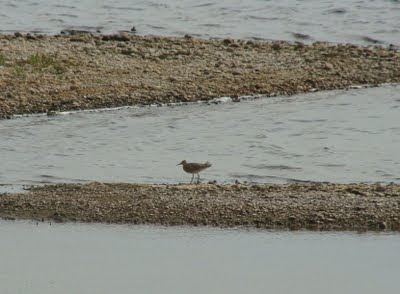
Curlew Sandpiper, RSPB Dungeness, 10/9/11
male Marsh Harrier soaring over reedbeds...always a treat
We headed off in search of lunch instead and found an excellent little pub on the shingle flats down by the power station. Sitting outside, we admired the endless parade of hirundines passing through. I've never seen so many together in the UK; everywhere you looked swallows and martins could be seen feeding acrobatically or momentarily resting, piled up on telegraph wires. An unexpected highlight amongt these flocks was an oddly late Swift which went whizzing overhead as we tucked into our chips. With the majority of swifts gone by early August, I'm not sure where this one has been; this bird charged through with all the grace and determination of someone whose alarm didn't go off and is late for their first day at work. A mooch on the beach bought more hirundine vismig - it was amazing to watch these small birds darting low over the waves, knowing it's just the start of their long journey.
Heading back we stopped off at the ARC pits opposite the RSPB entrance and squeezed into a busy hide. The Pectoral Sandpiper sighted the previous day was probably a bit of a draw but even without it there was still a lot on offer. Several hundred Golden Plover stood out amongst the Lapwing and numerous dabblers on the pools, but scope-less, I was reliant on others to pull out the stuff at the back. They obliged with a charming female Goosander and a drake Garganey in eclipse plumage. Finally, as  gorgeous evening light washed over the calm pools, my attention focused on several distant white blobs. One was certainly a Little Egret but as the other raised its head, revealing a stubby, yellow bill, I realised I was looking at a Cattle Egret. A regular but scarce UK visitor and fairly common across the channel, how long is it until they start sticking around for good?
The worst picture of a Cattle Egret you'll ever see. Who cares?! Life tick!
RSPB Dungeness & surrounds list (52) 10/9/11:
Linnet, Sand Martin, House Martin, Barn Swallow, Cetti’s Warbler, Oystercatcher, Mute Swan, Lapwing, Mallard, Coot, Pochard, Tufted duck, Gadwall, Herring Gull, Great Black-backed gull, Sandwich Tern, Great Crested Grebe, Greenshank, Marsh Harrier, Hobby, Grey Heron, Little Egret, Common Tern, Great Tit, Long-tailed Tit, Cormorant, Yellow Wagtail, N Wheatear (Greenlandic ssp.), Meadow Pipit, Common Sandpiper, Curlew Sandpiper, Starling, Rook, Lesser Black-backed gull, Greylag Goose, Swift, Dunlin, Teal, Wigeon, Cattle Egret, Golden Plover, Shoveler, Goosander, Garganey, Jackdaw, Carrion Crow, Black-headed gull, Pied Wagtail, poss .White Wagtail, Great Spotted Woodpecker, Woodpigeon, House Sparrow, Kestrel

Friday, 9 September 2011

Photoblog: Autumn Migration

Zug·un·ru·he
n.
The migratory drive in animals, especially birds.


OUT: Barn Swallows (Hirundo rustica) RSPB Northward Hill, 1/9/11
The well observed habit of swallows nervously fluttering on telelphone wires, preening and feeding, often signifies that departure is imminent. I'v heard that some swallows in the UK actually fly north prior to migrating, in a bid to make best use of the diminishing day length before a big 'push' en masse south. 

OUT: Northern Wheatear (Oenanthe oenanthe) St Mary's marsh, Hoo Pen. 22/8/11
Wheatears strike me as being an inquisitive bird, often hopping onto fence posts with head slightly cocked (as this photo shows) Then they are gone with a cheeky flash of their white tail coverts. An epic migrant; some sub-species of Wheatear breed in Greenand/Canada and winter in Africa.This bird however, a rather worn looking female I think, may have started her journey in the UK.
OUT: Yellow Wagtail (Motacilla flava) RSPB Elmley Marshes, August. A bird whose polite sneeze of a call, a faint but distinctive 'pit-tew', has soundtracked many of my marshland wanderings this summer. There are numerous European sub-species of yellow wag but the brownish-green crown/nape markings mark this as belonging to the British 'flavissima' (ssp) 
IN: Golden Plover (Pluvialis apricaria) A hundreds strong flock over the Swale Estuary.
A relatively short-distance migrant compared to those above. Golden Plovers can be found locally in the UK all year round but most breed on tundra in far northern Europe and spend winter in the milder climes of central and southern Europe. Check your local reservoir/pool/marshy area for these dazzlers this winter!