Cooling Marshes, Kent, 7th December 2014

Thursday, 13 February 2014

A musical interlude

I've had a busy few weeks of late with much of my free time being spent mostly trying to not weep with rage at the downright appalling way this government conducts its environmental affairs and refuses to listen to experts. But since the web is (thankfully) full of lovely, eloquent people covering that base, here's a short musical interlude instead...

Last Saturday I went to see Bill Callahan of Smog fame (or even of Bill Callahan fame if you like) at the Royal Festival Hall. I always enjoy going there; day or night it seems to be full of people hanging out or working or reading or just going up and down endlessly in the musical lift. It always feels grand to me inside and yet with welcoming public spaces, it feels almost genuinely anarchic at the same time - it seems these things rarely go together (although it stops at the price list on the bar). 

I enjoyed Bill's near two hour set although K thought it fell a bit flat. I kind of know what she meant but since it was my first time seeing him I had no reference points for comparison. I guess what I liked most was the way it's hard to tell which way his songs are going, he keeps you guessing. The songs can be tender, funny, surreal and all those things at once, any traditions are delicately trashed. A noisy mid-set outro on one of his new(?) numbers was a highlight, as was 'Riding for the Feeling' and 'Dress Sexy at my Funeral' (of course). I also like the fact that he makes regular references to nature in his songs, particularly birds and trees, and there was a good sprinkling throughout this set. The sound was great and his band were ace, so it was a pretty good way to spend a Saturday night.


An eagle came over the horizon and shook the branches with its sight
the softer thoughts: starlings, finches and wrens
the softer thoughts: they all took flight

All thoughts are prey to some beast - Bill Callahan

Sunday, 2 February 2014

Wallasea

My eyes are streaming from the wind and the scope wants to take off, just like my coffee flask did a moment ago. I glance over and see it lying in the mud. When I squint the wind's tears away the dazzling light takes over, masking the flooded field in front of me. A huge number of Lapwing are gathered on it but they are little more than softly squeaking silhouettes from my vantage point. Pulling my cap down further to give my eyes some respite, I can make out smaller waders at their feet, the pale forms of Dunlin, heads down and busy feeding in the shallow pool. Then all of a sudden, the shapes merge and rise into the air, into the wintry sunlight, into a vast open sky.

This is Wallasea Island, a spectacular wetland regeneration 'project' on the south east coast of Essex, sandwiched somewhere between the River Crouch and the old school slot machines in Southend on Sea. Epic in size and ambition, it's a fitting place to consider and celebrate World Wetlands Day today.

Wallasea Island, Essex, 1/2/14

World Wetlands Day marks the signing of the Ramsar Convention in Iran in 1971, a treaty that recognises the global importance of wetlands and seeks to maintain their conservation measures and promote sustainable use. In 2014, the theme is 'Wetlands and Agriculture' - two themes clearly on display at Wallasea Island. The intertidal mud flats, lagoons, salt marsh and fields here are part of a huge engineering scheme designed to recreate important habitats lost elsewhere in Britain as well as being an example of what can be achieved through sustainable farming practices and endless determination in the modern mitigation process.

Throughout our visit, a conveyor belt is transporting the spoils of Crossrail off a ship and straight onto the site, where large trucks are rolling it out. Mounds of earth flank new ditches that have been recently excavated. But none of this detracts from the landscape and the wildlife. During the day I thought about the fact that I seem to spend a great deal of time exploring places like this, more than woodlands for example - "traipsing round a marsh" as my girlfriend calls it. But I guess this is where I find myself drawn to the most, wetlands to me are fascinating...and full of birds. Even on a day when strong winds mean anything daring enough to raise a wing would likely end up in Belgium, there was plenty to see. A small flock of Golden plover huddled in a field on the drive in and skylarks frequently catapulted out of the grass as we passed along the sea wall. Large flocks of Brent geese, Shelduck and Teal occupied the mudflats while the quickly rising tide bought a smart Red-throated diver in for good views.

While today there is some basic infrastructure in place for visitors, it will be fascinating to see the site in 2019, when it is scheduled to be completed. In a sense though, it will never be completed because wetlands like this are always changing and they need to be given room to do that.

Kestrel in the grass
Emily in the grass

The BTO Wetland Bird Survey (WeBS) is a great way to discover the species using these important areas and how populations change over time. Check out the new online webs reports here.

Thursday, 30 January 2014

A familiar pair of legs

It seems that celebrities were all over Hoo Peninsular at the weekend. I made a quick visit to Cliffe on Saturday afternoon and was pleased to bump into one of its own:

C-ringed Greenshank, Cliffe Pools, 25/1/14

This colour-ringed Greenshank (Tringa nebularia) pictured on the left, was roosting with a small flock of birds at the top of Flamingo pool. That in itself was good to see but with a closer look I spotted the rings and recognised the colour combination - it was a familiar pair of legs. You might just be able to make out the small Green over Orange flags on its left tarsus.

I saw this bird twice last year, when, with the help of another local birder, I was given the ringers details. He was quickly able to confirm that this bird is something of a Cliffe Pools stalwart as it has been returning to Cliffe every winter since 2006. Ringed locally in August 2006, this individual often stays in the area until April before reappearing again in late summer or autumn. Where it goes in the meantime is a guess, presumably it migrates to a breeding site much further north. On its travels it has also made brief stops in Buckinghamshire and Cambridgeshire, but it is its remarkable site fidelity here that makes it a special bird indeed and shows that it clearly finds conditions to its liking. I was really happy to see it back again for another year.

Sunday, 26 January 2014

Medway WeBS and an unusual visitor


Medway and Darnet Fort from Hoo Industrial Park

I did my January WeBS count yesterday morning when conditions were thankfully a lot better than they were in the afternoon! With some low cloud obscuring the Kingsnorth chimney at first, by mid-morning the sky was clear and bright over the Medway. The results are largely similar to December's although I think the tide must have been slightly lower today as little could be seen in the creeks stretching across the mud. Occasionally small flocks of redshanks and Dunlin appeared, only to sink out of sight immediately. Brent geese were present in good number and Teal numbers were up slightly.

Totals for 3 sectors (Hoo Flats):

Mute Swan 2
Dark-bellied Brent Goose 111
Shelduck 190
Teal 330
Pintail 5
Cormorant 9
Little Egret 1
Great Crested Grebe 1
Oystercatcher 113
Grey Plover 6
Lapwing 25
Dunlin (present)
Curlew 26
Redshank c20
Gulls (5 species present)

Before the count, I walked around the sea wall as far as the marsh by the power station where a flock of 150 Brent geese and 50 Greylag geese were gathered - some of the former departing for the flats shortly after. Passerines of note included Song Thrush, 2-3 Linnet and 6 Meadow Pipit. A flock of 75 Fieldfare were present in the adjacent fields and a Cetti's Warbler gave a short blast from a small reedbed. The most surprising sighting of the morning though was undoubtedly this beast:


Yee Haw!

While I was sifting through a line of hazy shapes out on the mud, I started becoming aware of alarm calls behind me. After a minute, with it still going on, I turned around and saw this perched up in some scrub about 30ft away! My head was scrambled for a second thinking 'that's a bloody weird Buzzard' until I realised it seemed to be a Harris's Hawk, a non-native raptor more commonly found in southern USA and Central America. It just shows you never know what's going to turn up! Harris hawks are one of the most popular birds for falconers in Britain and sightings of escapes are not unheard of. This bird had clear rings on both feet (but no jesses) and appeared to be quite agitated. After a minute it flew off low into some scrub and I didn't see it again. Still, a stunning bird regardless of origins.

Tuesday, 21 January 2014

The Brecks to the Broads

Hockham Fen, Norfolk, 16/1/14

January birthdays are not a hugely popular time of year for outdoor revelry but it never dampens my enthusiasm for this time of year. With mine falling square in the month, I had a couple of days off last week and headed up to Norfolk with a plan hastily traced from a range of Ordnance Survey maps. All that un-folding and folding, it was an origami massacre.

But it was lovely to discover new areas of a county I always enjoy visiting. We ate well and slept well and strangely, pleasingly, my phone barely ever had any reception. A simple glitch that only reinforced our sense of place, even if it was only just passed Thetford! I suppose it was a fitting modern solitude for a clear day spent following the Peddars Way, a Roman (or pre-Roman) track that cuts through the western side of Norfolk from Holme down to Suffolk. Although underfoot it may have changed, with gravel and traffic-less lanes in  places, its landscape and story remains. Our circular route from Thompson took us on a narrow path that weaved through slender carr woodlands of the gloriously named Cranberry Rough before opening up to reveal the wild expanse of Hockham Fen. Places like this make me feel like a time traveller, and that is a wonderful thing.

Along this way it was nice to see a number of Marsh tits, a relative scarcity where I live. We also encountered a couple of Brambling drinking from a puddle in a woodland clearing with chaffinches and enjoyed a buzzing flock of siskins by a stream. At one point we came to a lane, the lane in your dreams - narrow, rutted and flanked with hedgerows. I thought it looked like the kind of place you should see Yellowhammers. We saw Yellowhammers.

Having joined the Peddars Way, we then veered off to explore some 'Pingos', or rare local geological features that formed at the end of the last ice age. Here, large underground pockets of ice expanded upwards and thawed, leaving odd, delicately formed pools. Apparently many were lost to ploughing and drainage during the last century but those that have remained form valuable ecological microhabitats for many species, particularly aquatic invertebrates.

The final stop on the Norfolk mini-tour was Hickling broad and coast, by way of the lush Yare Valley and the large numbers of Bean and White-fronted geese at Cantley marshes. In Hickling, the famed Stubb's Mill raptor roost kept one of us warm at least, as the sun dropped and the Marsh harriers swept in from all directions. I'm not sure how many appeared in total but forty birds wouldn't be unreasonable, with 15+ visible at one time. As these majestic shapes hung choosily over the extensive reedbeds that fill vast pockets of this rich and varied landscape, a couple of Hen Harriers appeared, fast and low in that way of theirs; a silvery male was the pick of the day.

Saturday started fair and grey as we went to see the Grey seals at Horsey Gap. Climbing up to a viewpoint on the dunes, I got a nice surprise as two Snow buntings flew out from under my feet and proceeded to pick at the grass heads strewn on the path. On the beach the seals and their pups lolled about while a few frisky ones jumped around in the surf. From the top of the dunes we had good views of the surrounding marshes and farmland and it was only a moment before I spotted several Cranes grazing in muddy, waterlogged field near Horsey Wind Pump. It's fantastic that this is no longer greeted with surprise. Some way along the dunes, peering through a fenced off part of the beach, I spotted a number of large gulls gathered. As I moved closer they revealed a fresh seal carcass on the sand - perhaps a victim of the recent storms? Interestingly the skitterish gulls were immediately replaced around it by some Turnstones and a Sanderling, the two small and surprisingly opportunist waders tucking into the flesh. While watching this, I noticed a crow land on the beach nearby. I nearly paid it no attention but was glad of a double take as it revealed it was a Hooded Crow, the furthest south I've seen one in Britain.

For the rest of the day we drifted on our own path, avoiding civilisation for as long we could, until we blinked and were somehow home again. A great birthday trip.

The Peddar's Way near Thompson
Thompson Water NWT
Stonechat (Saxicola torquatus) at Horsey dunes
Lunch at Horsey Gap
Grey seals (Halichoerus grypus) on the beach

Sunday, 12 January 2014

Showing Well

Yesterday afternoon I headed down to Brighton to see the Grey Phalarope that had spent the week on a children's paddling pool on Hove seafront. Some of the photos coming out were incredible so I couldn't pass up the opportunity to see it for myself. As we arrived in the vicinity I was initially a bit worried that it had moved on; I mean, a sunny Saturday on the coast and the nearby promenade and green were little more than a heaving mass of children, dogs and dog walkers, all barking. Something in this distracting combination must've spooked it finally?

But no, on a small, fenced off paddling pool, sandwiched between a play area and a skate park, there it was...a tiny, pale wader, glowing in the soft light and spinning contentedly for a motley gathering of birders, photographers and curious locals. While my girlfriend didn't quite see what the fuss was about ("we came all the way here to see that?! It's tiny!"), the views were incredible:


True to form, it never stopped moving, continuously feeding in the shallow pool and around the edges. I don't know what it was finding to eat, perhaps larvae or insects washed in with the last heavy rains...I'm not sure. But nevertheless, it didn't seemed bothered by the crowds or the noise and only really alarmed momentarily when a crow landed by the pool for a drink. Still, it's clearly found a sheltered spot to its liking, with an endless passing parade of men in high performance outdoor wear currently a better alternative to the energy-sapping winds and strong seas it would encounter en route to Africa.

All in all it was a lovely few hours. After I'd got dizzy watching it for a while we walked down to the pier to watch the starlings roost. I hadn't expected much from recent reports so was pleased to see decent numbers circling high over the town, perhaps 5-10,000 birds overall. There was no murmuration as such, rather they went straight in under the rafters of the pier, but we both agreed it was still a stunning sight as the sun dropped behind. All in all, a great day and an old-school twitch as well - we took the train!


Keeping up the leisurely pace, today I headed to Ramsgate to see the presumed Hume's Leaf Warbler in the cemetery. Arriving late morning, the bird was instantly to be found darting around the bare canopy of a Horse Chestnut on the main driveway. Flitting between here and a nearby pine tree, the views were excellent and it one point it even beat the phalarope for showy-ness as it landed just above my head. Although I'm not entirely up to speed, there's been some debate about the identity of this bird, with some doubt raised over its range of vocalisations, making separation from the near identical Yellow-browed Warbler difficult. The majority now seems to favour it being a Hume's, which from what I saw and heard today, I'd be happy to go with. My overall impression in the field was of a distinctly 'washed out' phyllosc warbler with green/grey tones and a pale underside. It's legs appeared generally dark and both supercilium and wing bars were not particularly sharp. Although I have very limited experience with anything like this, it seemed to fit the description in my field guide pretty well, although it was interesting what a difference certain lighting made. As for the disputed calls that it eventually began making, well, I can't really add anything but I do think that the majority fit with these recorded before by Graham Catley of a British bird at Gibraltar Point on Xeno-Canto - very wagtail like as someone noted. But anyway, brilliant views in the sun and a great bird regardless. 

Hume's Leaf Warbler (Phylloscopus humei), Ramsgate Cemetery, 12/1/14

Afterwards I had a walk around the harbour and was pleased to see a fine Shag in breeding plumage swimming around, while along the cliffs some Fulmars were cackling loudly. 


Two very confiding birds and an excellent weekend out and about.

Thursday, 9 January 2014

2013: A Year to Remember

Chesil Beach, Dorset, 30/12/13

Ok, I'm a little late with an 'end of year post' and you're no doubt sick of them anyway, but bear with me!

From my own birding perspective, 2013 was a great year and one I'm sure I'll look back on fondly in the future. How can I pick a highlight? I saw a flippin' Roller for starters and a Dodgy Thrush too. Then there was Red-backed Shrike, Penduline Tit, Red-footed Falcon, White-tailed Eagle, Pacific Swift, Pied-billed Grebe, Bluethroat...In short: I saw a lot of fantastic birds (and that was just in Britain).

But it's not always about glamorous migrants or vagrants; I'd wager that the afternoon I found my first Lesser Spotted Woodpecker will linger in my memory as much as any of the above  - a small, resident woodland bird that is sadly becoming harder to find. How could I forget the Farne Islands too? And staring, cross-legged on a rock, little more than a metre from a pair of shags tenderly entwining their long necks in each other, reaffirming the bond. Nature just carrying on while we gawped. Wow, The Farnes. Those are moments that matter.

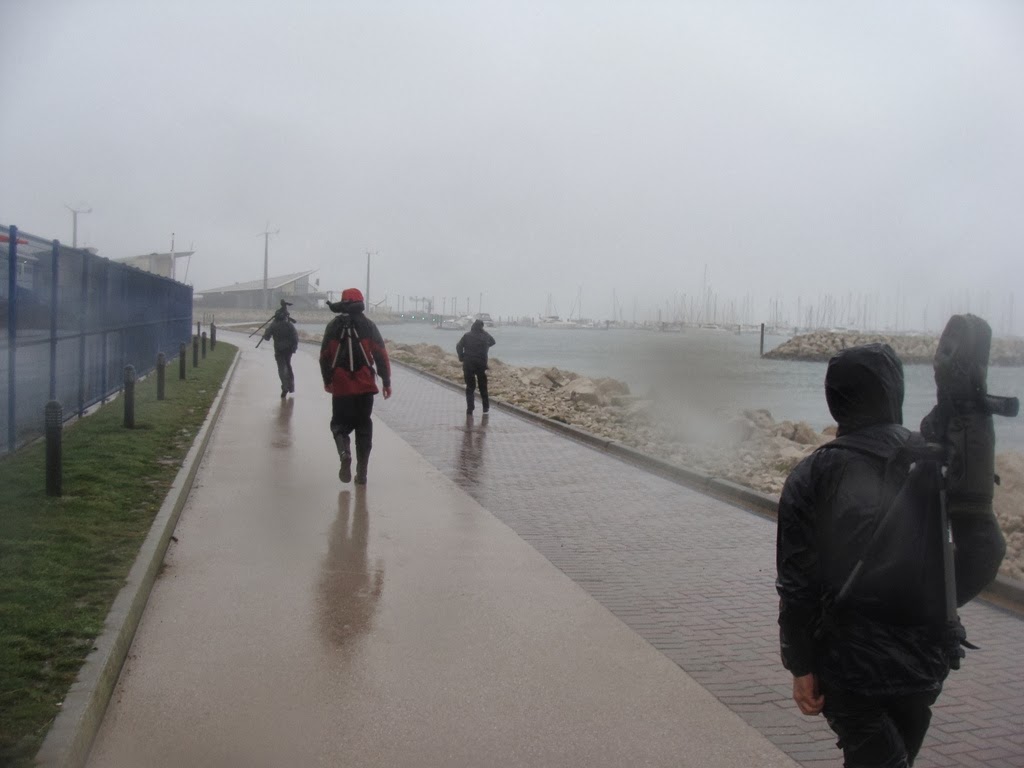
However, it was fitting that a great year should end in style with a trip down to Dorset just before New Year's to see the Brunnich's Guillemot spending the holiday period in Portland Marina. You've probably seen everyone's photos on twitter already but needless to say it was an excellent trip and well worth the early start. Arriving just after 9.30, things initially looked pretty bleak as rain streaked 40mph+ winds determinedly wrestled any standing object but I was soon put on the bird and it went on to show brilliantly for an hour and a half. At one point it popped up no more than fifteen metres from me, the closest I've ever been to the Arctic Circle. It's key characteristics were all easily seen in the field, the pale gape-line and dark 'smudged' cheek, overall at distance it seemed very 'sturdy' and the contrasting black and white plumage was striking. There can't be many occasions when you hurry past a Black-throated Diver to see something else but this was a special bird. The difficult conditions had created something of a birdwatcher's chocolate box in the harbour and at times I didn't know where to look. All three diver species were present, Red-breasted Mergansers were numerous and a Shag popped up too. It was a fantastic few hours and the sun even came out in the end.

Leaving Portland I stopped at Chesil Beach for a bit to take in a feature of so many geography essays I wrote at school. Against the now-blue sky, the sea boiled like violent mushroom soup and gulls hung over the crashing waves. On the shallow side of the shingle ridge, in the lee of the wind, a flock of Brent geese chilled on a pool while a roost of large gulls were joined by a smart Mediterranean Gull.

Having decided against heading another two hours south for the White-billed Diver at Brixham, I charted a course home, first via an incredibly confiding Glossy Ibis on a flooded football pitch in Weymouth and then on to Studland in Poole Harbour for a Surf Scoter. Unlike the Ibis, the scoter was a hard catch, mostly because finding the right spot was tricky. But thankfully I bumped into a couple more birders who were just as confused and between us we worked it out. With the sun dipping quickly, we eventually got on the bird, albeit at some distance. Again, another heap of great birds could be seen before the light faded on the penultimate day of 2013.

Brunnich's Guillemot (Uria lomvia), Portland Marina, 30/12/13
Glossy Ibis (Plegadis falcinellus), Radipole Drive playing fields, Weymouth, 30/12/13

So 2013 was a year to remember, here's to the next one...I wonder if I'll see a Turtle Dove?