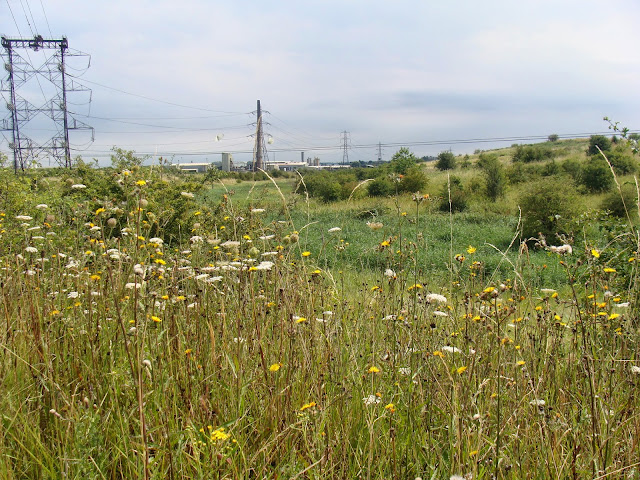
Cooling Marshes, Kent, 7th December 2014
Showing posts with label North Kent Marshes. Show all posts

Saturday, 12 September 2015

Can you hear the nightingales sing? (Part 3)

It had all gone quiet on the Lodge Hill front recently...until this headline rather came out of nowhere yesterday:


The BBC reported on it here and Miles King provided this interesting blog on the news.

Too early to celebrate? Perhaps, but this is certainly a welcome development in the saga.
"We have recognised a loss of £11.3m due to increased uncertainty over the recoverability of our costs to date following the disappointing decision by the Secretary of State to call in the proposed scheme for public inquiry"
I'm not sure what they've spent £11.3 million on so far but with an experienced developer like Land Securities releasing a quote like this, who would want to step up in their place?

Lodge Hill has been shown time and again to be a site of unique value for wildlife on a local and national scale. It's time that the MOD ceased this reckless pursuit and perhaps took a look at the positive steps taken by the German government with regards former military bases. Similarly, Medway Council needs to take this opportunity to re-evaluate their planning strategy. Chattenden is not the place for a development on this scale, it's time to move on.

Monday, 16 February 2015

The light returning

Estuary sunset. Looking across Cliffe creek to Gravesend and Tilbury.

Out on the marshes the light lasts longer; it travels for miles, through reeds and scrub, across rank fields dotted with grazing livestock, it blazes across the pools, pink, blue and purple.

I made a late visit to Cliffe yesterday, arriving with the mixed throngs of wigeon and lapwing already uttering their restless pre-roost assurances from the causways snaking across the site. From their midst, the barks of noisy greylag geese drifted across the water. The pools were flat calm, so much that a little grebe diving under the surface fifty metres away was more of an event than usual. Not much stirred but I was able to pick out the wintering male scaup among some tufted ducks on radar pool. 

In the peachy dusk cast over Flamingo pool, coots made for their corners and a distant harrier stirred up all manner of squeals as it passed. A pair of goldeneye drifted close by, the resplendent male head bobbing as it went. Wild swans have been scarce in the area this winter so I was pleased to catch up with a party of seven bewick's swans, one of my favourite seasonal migrants, roosting on the beach. Paddling serenely or half-asleep, it's a wonder to think of all the land that will be passing beneath their powerful wings on the journey they'll soon be taking back to Siberia.

From the sea wall I watched the sun's fiery slick across the water meander to nothing as it dropped into some untraceable suburban shadows beyond Gravesend. In its absence, under the clear evening sky, misty patches appeared along the edges of the track like snagged wool on a wire fence. The mist clung low to the damp fields but I could still make out the shapes of harriers drifting in, gliding silently over the reeds, ever lower until they too were gone.

From the track, teal and mallards called in the dim light but above it all rose the formidable shrieks of a song thrush deep within its guarded hawthorn thicket. Although not quite at its peak, a little rusty perhaps, there was no mistaking its sure understanding that the light will soon be returning.  

male Goldeneye (Bucephala clangula), Cliffe Pools, 15/2/15 
Bewick's Swan (Cygnus columbianus bewickii), Cliffe Pools, 15/2/15

Thursday, 11 December 2014

On the margins of Land and Sea

It was a wonderful weekend just gone, one spent on sparse, sloshing fields stripped of seed, flower or scent, but still full of promise as the seasons reach their ebb.

On Saturday, with a bright winter sky rising, I set off early for East Sheppey, one of my favourite destinations at this time of year. I pondered my plan for the day en route before settling on the usual walk. I crawled along the Harty Ferry Road where the fields were subdued under a heavy frost and little stirred besides a breakfasting kestrel. Past Capel Fleet, house sparrows picked at gutter grit and disappeared into the hedgerows as I passed. Abandoning machine for mind, I soon set out down the track towards Sayes Court looking forward to the day ahead. The copses and hedgerows sparked into life with winter thrushes, woodpecker and finch. Down towards the marsh a hundred and more linnet clung to weedy stems of maize while the first of a dozen stonechats performed nimble aerial feats in a survey of their surroundings.

On the old, grassy seawall I stood somewhere on the margin of land and sea, but safely separated from the realm of water on either side. Small flocks of brent geese flew in off the Swale to join an impressive thousand-strong flock snaking across a distant field like an exposed coal seam. In the small hide I was joined by another birder and between us we traded a Hooded Crow on the marsh for a ring-tail Hen Harrier patrolling a strip of setaside. I quietly admired the handful of White-fronted geese, their tiger-striped flanks, which kept company with the greylags.

Swale NNR, Sheppey; looking west to Shellness
Hooded Crow (Corvus cornix)
Redshank (Tringa totanus), Shellness point

The tide was up at Shellness point where a large mixed flock of waders were packed into the roost, all legs and huddled grey bodies.

At Muswell Manor I walked the track back to Harty as shadows grew ever longer; although not much past lunchtime, the sun's plight was already perceptible. On a fence post a Peregrine flexed its wing before taking off on a lazy swoop at some woodpigeons. Watching its flight I caught sight of another and between the two of them a perfect chaos ensured in the blue skies. Back at the top, sparrows still squabbled in the dirt as I made my way to Capel Fleet. In keeping with the day, the mound was almost deserted. A ringtail Hen Harrier soon appeared quartering a ditch at some distance, before a male ghosted across its path. Ghosted is the word. For in the impeccable winter's light softly falling behind me, teasing each detail, he glowed - all save those inky black wingtips.

Dusk bought the cold back and fingerless glove regret but it was tempered by a fiery evening sky. A woodcock fluttered over and starlings whistled restlessly in the reeds before, in the dim light, two short-eared owls could be seen making silent swoops over the grassland. I squinted after them until even that became too much, the fields merging into one against a blazing sunset.

Hen Harrier by ATM, Shellness
Sunset over Capel Fleet

(Title by JS - thanks, I always liked it)

Thursday, 6 November 2014

Swanscombe Peninsular plans revealed

I went to the latest round of community consultations for the proposed development of Swanscombe Peninsular last night - the so-called London Paramount 'entertainment resort'. It was pretty interesting.

Being the second round of events there was more information and more detail on show this time, including a map of the site and the outlined planning boundary. Having seen both these now, I stand by my initial concerns.

Proposed London Paramount planning boundary - Nov 2014

This graphic above shows the proposed boundary of the planning application. I was surprised to see such an extensive area of land included south of the main peninsular. This is apparently to cover for likely 'infrastructure works' needed to accommodate the massive amount of people/vehicle traffic predicted. A spur road off the A2 is suggested. Note several large arable fields are included south of the A2 section.

I found it amusing that by way of introducing this consultation, London Paramount chose to include a panel acknowledging the 'History of Pleasure Gardens' and the subsequent "explosion of interest in the Thames as a leisure source". Included were several sepia photographs of piers and beach huts from locations along the river many, many years ago. So I guess what they're really trying to say is that these kind of these things are part of our cultural heritage anyway and who are we to deny that? "In many ways, pleasure gardens were the amusement parks of Georgian England!". I added the exclamation mark, it felt like it needed one.

There was more information this time on the environmental issues which was good to see. Their aspiration is for the resort to be "heralded as setting a new standard for environmentalism" and to "maximise the role of the river and the wonderful marshes surrounding the site". I like the latter line much more than the meaningless first part. There was mention of education opportunities, SUDS and "biodiverse green roofs", that means 'green roofs' - the word 'biodiversity' was used pretty liberally for my liking.

Here is the 'masterplan' for Swanscombe Peninsular as it stands:


So Black Duck Marsh, Broadness and (half of) Botany Marsh have been spared. However it in no way makes up for the fact that the orange monstrosity in the middle is going to have a huge impact on the ability of the site's wild flora and fauna to thrive and will irrevocably alter the sites open character. Given that when questioned, I received a pretty evasive answer about the area marked for 'Possible Future Expansion' (it would remain untouched at point of opening) it seems inevitable in this plan that the site's habitats will be diced up and fragmented with no thought to connectivity. In the first consultation I was told "we'd be stupid to build right up to the river" and yet this plan comes pretty close to achieving that, never mind that it looks like the jetty roost will disappear to make way for a new river taxi/ferry terminal. With 15 million annual visitors (!) predicted and all the subsequent noise, light pollution and disturbance, how do you think the wildlife on site will fare?

What we'd lose most here is another expansive sweep of North Kent's marshes. Ignore the 'brownfield' tag, to me, sites like this are the essence of  a modern wilderness; it's an open space, forgotten by industry (and most people) but taken on by nature. London Paramount describe the site as "isolated by its previous industrial uses" and an ITV news article called it "pretty much derelict" - interesting choice of phrases here. No human use, therefore no value.

You can stamp 'biodiversity' on a million pieces of paper and you will never recreate sites like this; so unusual and exciting and filled with a sense of recovery. It is early days and I look forward to seeing how plans develop.

Swanscombe Marshes, June 2014 (photo taken from within the proposed orange 'leisure area') - read my blog about it here:


If you get a chance to go to the current presentations - the dates and locations are here. Please do. Alternatively you can write to London Paramount here. All comments welcome below too.

Even better - why not pay the site a visit? It's great. Here are some recent bird sightings (thanks RK):

Bearded Tit, Shoveler, Gadwall, Teal, Snipe, Little Egret, Marsh Harrier, Reed Bunting (7), Stonechat, Cett's Warbler, Water Rail

Monday, 3 November 2014

Egypt Bay and Northward Hill 1/11/14


Out there on the marsh, beneath the hill already ominously shadowed by the last minutes of light in the day, comes one of nature’s grandest curtain calls. It is a smattering at first, of lone cries and polite applause, before the sky turns a shade darker than dusk with the sight of a mob approaching. Dressed impeccably and quite perceptibly in black, the rooks are returning to roost.

The noise is incredible and it feels like the whole landscape of the Hoo Peninsula trembles with it. In the bushes some blackbirds shriek and a tawny owl hoots nearby, but all else is indecipherable. On the marsh, after a bright autumn day spent probing the lumpy, grazed turf, the sound is a quarrel; overhead it becomes a glorious riot. The birds stream in in their hundreds. In the glowing dusk their shapes swarm together before they slowly descend into the hill and the trees there become full of it. In the dark, amid the flash of wings and the endless cries, it would be easy to think that chaos reigns. But they know exactly what they’re doing; they've been doing it for centuries.


Rooks at Northward Hill, 1/11/14


The rooks were the final act of a good day out at Egypt Bay and St Mary’s on Saturday. The walk out from Swigshole brought a pair of stonechat, a green woodpecker and numerous blackbirds and chaffinches in the track-side bushes. At Egypt Bay I checked out the workings for the planned breaching nearby and found a colour-ringed adult lesser black-backed gull already settled in. Unfortunately its details were too far to read. On the river was a pair of great crested grebes while the swathes of exposed mud held an assortment of waders and wildfowl. There were small numbers of wigeon and shelduck along with many curlew and dunlin. Crossing over the water from Coryton, I picked out a bird moving fast and low with pointed wings which, banking into the light, turned out to be a kestrel. Nearby, I watched a small flock of knot feed hungrily alongside some watchful grey plovers. I was surprised to see several butterflies still on the wing, including a small tortoiseshell and several clouded yellows - the latter clinging to dandelions in a final, defiant grip of summer. The highlight of the afternoon however was a female merlin perched on a fence post briefly before taking off and having a swipe at a meadow pipit. It missed, but like the rooks and all the rest, it played its part on a truly epic stage.


There ain't no mud like estuary mud: Wigeon near Egypt Bay
Brent Geese over St Mary's Bay

Links:

Sunday, 28 September 2014

Bucket List

After a busy week, I felt in great need of some wide open space today so I headed to Cliffe and the marshes. I know of few landscapes more soothing to my mind, or more rewarding for the nature-lover than this expanse of estuary and today it delivered on both.

With the heavy morning haze burning off to leave a bright, simmering autumn day, I started in Cliffe church yard amidst a din of whistling starlings. A few goldcrests called from the boundary oaks along with two handsome, fresh chiffchaffs. Several dunnocks peeped and, as I glanced up in the direction of a rattling mistle thrush, two swallows zipped by the tower.

Down on the rspb reserve it wasn't long before I spotted the long-staying, immature spoonbill roosting on one of the ski pool islands. Further scanning brought my first two pintails of the autumn, along with a single ruff and greenshank. The pools were ruled by fleets of coots. With high tide some way off there was little of note on Flamingo - a few more pintails sailed serenely by and dozens of little egrets strutted along the weedy edges, but lapwings were conspicuous once again. Even relatively early in the day, the air was thick with insect life and crane flies and flies of all sorts continually bounced off me. Dragonflies and darters buzzed through the scrub and a clouded yellow butterfly kicked up and charged past me on the track down to the river. The butterflies it seems were enjoying the balmy autumn weather with clouded yellows abundant along the river wall. From a personal perspective, it seems to have been a good year too for wall butterflies and another one lived up to its name today, flitting amongst the grass in the sunny seclusion of the river wall at the Thames View Point.

With only the slightest easterly breeze I expected the river to be quiet, so it was nice to see two juvenile kittiwakes flying up and down mid-channel between passing ships. While watching these my eye fell unexpectedly on the large, dark shape of a juvenile gannet flying low over the water, down river away from me. Walking east along the wall, black-headed gulls and several common gulls made up the throng, hawking high over head  for the insect bounty. At Lower Hope Point, utilising an upturned bucket, I was happy just to sit and watch the river flow for a while. At one point I head a distant, hoarse tern call and managed to pick out a small bird with discreet black head markings mid-river. With a good view difficult due to the haze, a black-headed gull did me a favour by flying along side it and dwarfing my bird in the process - revealing a presumably juvenile little tern.

Plodding on, I passed a family sat quietly on the bank and a fisherman on the saltings doing little more than I had been, minus a bucket. Beyond him I could see birds scurrying back and forth on the sea wall and, edging closer, saw eight of them were stonechats, hurriedly feeding on the swarming flies. They were joined at the banquet by four wheatears and yet more meadow pipits. I could watch wheatears all day long and maybe, because I knew these might be the last ones I see this year, they looked extra smart. Walking back, I met the fisherman again and stopped to ask about his catch. Not good, nothing in fact. He told me how he used to catch cod there years ago but not any more in this part of the estuary. I wondered if this was due to disturbance and the new port development but he thought it was overfishing. He went on to say how he'd been visiting the same stretch of river for 45 years and some of the things that had changed on the marshes. He wasn't hopeful but it was interesting and I liked hearing about it.

Heading back around by Allen's pond, I heard the shrill whistle of a kingfisher and crept round in time to see a bird perched in some dead, overhanging buddleia. It was gone in a flash but I stayed and waited and it soon returned. Again, I was happy just to sit and stare, surrounded by the sweet, slurred calls of chiffchaffs as they pinged about the dense undergrowth.

Saturday, 13 September 2014

Shrike at Shorne

A couple of digiscoped photos of the Red-backed Shrike (Lanius collurio) at Shorne Marshes RSPB, North Kent, today -  first reported yesterday afternoon.

'Ave a butcher's:


I stopped by Shorne on my way home from ringing on the off chance that the bird might still be around. Thankfully after half an hour scanning from the tow path, I caught a glimpse of something shrike-like perched on a bush, but only a split second before a Sparrowhawk tore through in pursuit of something and the bird dived into cover. Thankfully, after watching the area a shrike did appear a few minutes later and showed well for a few minutes before disappearing again. The bird appeared less marked/barred than juveniles I've seen in Europe but this may have been an effect of the bright sun overhead, still, a great bird to see as ever.

Although only a brief trip to Shorne, it was good to visit again. A Hobby put on a good show which I shared with a passing cyclist and there were nice views of a juvenile Marsh Harrier too. The towpath scrub held a few calling blackcaps and chiffchaffs and nearby there were more signs of autumn with two flocks of Jays passing high over the marsh - nine birds in all. Some of the local residents were also preparing for autumn - yes, the sheep of Shorne were being shorn...


The guy in the middle is a record holder for sheep shearing apparently...

Thursday, 11 September 2014

The last song for Lodge Hill?

Part of Lodge Hill and Chattenden Woods, Hoo Peninsular, Kent, 2013

I didn’t sleep much last Thursday night. This came as a result of flicking through twitter in the evening and reading the news that Medway Council have approved the controversial Lodge Hill development on the Hoo Peninsular, near where I live. The plan is for a 5000 unit, new town development in the middle of a SSSI site. I stared at it, my temperature rising, utterly shocked at the decision.

The timing was surely no coincidence – with local communities and campaigners far and wide (not to mention national and local media) largely distracted by the government's Airports Commission result and the fate of a hub airport in the Thames estuary due two days before it. After that positive outcome and the widespread relief that followed, this feels like a case of one step forward, two back.

I've written about Lodge Hill and Chattenden Woods before. It is, in short, a remarkable place; for birds – including the Nightingale, a beautifully subtle woodland blur, but a bird that yells it's secret with unparalleled melody and power. It is a protected and rapidly declining migrant species (a 60% decline in just c15 years between 1995 and 2009, BTO) which breeds on the site and the close vicinity in nationally significant numbers (84 pairs, BTO, 2012). It is a site full of rare and interesting invertebrates thriving in a range of habitats. It has archaeological importance and tracts of grassland that are difficult to describe but seldom seen elsewhere in the area!

Now picture a warm summer's evening at Lodge Hill, some time in the future; dozy moths flit beneath the soft lights of a Tesco Metro, the scent of fried chicken catches the breeze and 10,000 cats defecate on patchy lawns thinking about what bird they might eat next. Ok, maybe I'm exaggerating...but what happens to everything I mentioned above?

The answer is apparently 'offsetting' the nightingales to a remote part of the Essex coast - creating habitat in the hope (and only hope) that they come. For all the talk and proposals written, a nightingale's behaviour can't be predicted on this scale - at any rate, the pressure placed on them in the meantime would most likely break an already fragile population. It is no coincidence that these birds have made their home here. As for everything else? Well, plans include a nice, managed country park for them.

It’s not always just about the headline acts though; the Lodge Hill and Chattenden Woods complex supports a vast array of common or locally scarce species, all of which have a place in our local natural heritage. What struck me, when talking this news through with my Dad, was that it wasn’t the impact on the nightingales or the scrub or all the brilliant insects that I recalled until later. What came immediately to mind was the impact the potential development would have on a wider environmental scale. The area upon which Lodge Hill lies could be seen as the cornerstone of a landscape that, bar the blinking lights of the power station at Grain and its associated industries, is still largely dominated by small, rural settlements and farming. The plans to stick a new town in the middle of it, and ride rough shod over a government-approved environmental designation, will irrevocably alter one of the last tracts of wild, open land in the South East. The consequences of this will be felt by many and creep far beyond the edge the wood, down to the estuary shores and continue across much of the country.

The view from the top - a sensitive landscape
Peacock butterfly (Inachis io) sunning itself in a Chattenden Wood ride, April 2013

Despite feeling exhausted, Friday worked out well in the end. It was good to be busy so as not to think too much about all this. And when I finally did start to look at my phone again I could see things happening, there were angry tweets, passionate blogs, media reports and messages from friends. It was great.

Sitting on the train home in the evening, looking for a distraction, I got round to finishing 'Cider with Rosie'. I can't quite believe it's taken me so long to read it but I'm glad I have - it's an absolute joy. I plodded through but only because I couldn't help but savour Laurie Lee's words; I read some passages over and over again throughout, with vivid pictures forming in my imagination. It was perhaps fitting that my journey should include the last chapter. Here he recalls the dramatic changes taking place in his small village in the late 1920's, a gathering of pace that led him to write "I belonged to that generation which saw, by chance, the end of a thousand years' life". Those words stuck to me.

For Medway Council to brand this development as "sustainable" is either a downright lie or exposes a frightening and twisted cynicism, born from a shocking lack of responsibility and understanding. I don't suppose the blame for this decision can fall squarely on Medway Council, I would imagine they have been placed under great pressure from the developers, Land Securities, who are looking to boost their strategic south eastern 'portfolio' in the wake of the Ebbsfleet 'Garden City' reprise. Internal influences no doubt played a part too.

Medway and North Kent has been blessed with many wonderful sites of national natural importance - Lodge Hill is right up there. Those in power, the decision makers, have a responsibility to all of us to recognise this. It is a site which confounds and amazes and to knowingly erase it, depriving future generations of a chance to discover something so unique, would be tragic.

Thankfully, it's not over yet, there is a still a chance and that's better than none -

Please help by urging Eric Pickles, Secretary of State, to 'call in' this decision and stop the development.

(Also check out the RSPB website for updates and Miles King's excellent blog for reports on Lodge Hill and a range of issues)

Let's hope that this isn't an encore and come next April, the April after that, and all the April's to come, the rides and scrubby copses of this incredible site will continue to ring to the sound of something irreplaceable...

Nightingale singing at Lodge Hill, 20th April 2013:


Thanks for reading (photos by me - feel free to use/share them)

Saturday, 2 August 2014

Ancient Avocet at Cliffe!

colour-ringed Avocet (Recurvirostra avosetta) Cliffe Pools, 29/4/14

On the 29th April this year, I saw this Avocet (above) feeding on the small pool in the area known as 'coastguards' at Cliffe Pools rspb reserve. Scanning across, with the bird showing comfortably at good range, I noticed the colour rings on its legs (Left: Red/Yellow, R: Yellow) so noted down the pattern and digiscoped a passable photo for my records. I've seen colour ringed avocets at the site before but never succeeded in getting any results from the various online resources.

After similar efforts with this this bird, I was expecting the same outcome so I was pleased to get an email last week which suggested it's history could be traced and requested my photo. Shortly after I received an email from the ringer, John Middleton, with the bird's history which turned out to be very interesting!

It turns out that this bird was ringed on 02/07/1990 at Titchwell, Norfolk, and these are the subsequent sightings:

Seen
   Date
Until
Holme, Norfolk
08/08/1990

Havergate, Suffolk
13/08/1990

Funton, Kent
16/12/1990
13/01/1991
Elmley, Kent
09/03/1991

Elmley, Kent
29/04/1991

Elmley, Kent
18/05/1991

Elmley, Kent
25/05/1991

Minsmere, Suffolk
10/06/1991

Havergate, Suffolk
03/11/1991

Havergate, Suffolk
15/11/1991

Tamar, Devon
07/12/1991
27/12/1991
Exe, Devon
28/12/1991

Exe, Devon
02/03/1992

Titchwell, Norfolk
21/03/1992

Snettisham, Norfolk
05/05/1992

Elmley, Kent
??/05/1992

Rushenden, Kent
??/05/1992
??/06/1992
Titchwell, Norfolk
31/07/1992
01/08/1992
Funton, Kent
11/10/1992

Rushenden, Kent
??/05/1993

Funton, Kent
18/09/1993

Titchwell, Norfolk
01/07/1994

Elmley, Kent
06/10/1994
07/10/1994
Blythburgh, Suffolk
30/01/1999

Titchwell, Norfolk
20/03/1999

Snettisham, Norfolk
28/03/1999

Titchwell, Norfolk
30/03/1999

Titchwell, Norfolk
28/02/2000

Titchwell, Norfolk
29/07/2005

Titchwell, Norfolk
17/07/2006

Two Tree Island, Leigh-on-Sea, Essex
11/02/2012

Two Tree Island, Leigh-on-Sea, Essex
10/11/2012

Two Tree Island, Leigh-on-Sea, Essex
11/12/2012

Two Tree Island, Leigh-on-Sea, Essex
26/01/2013

Two Tree Island, Leigh-on-Sea, Essex
25/02/2013


I knew that waders can be long lived but I had to do a double take when I saw that initial date! These records mean that when I saw this bird, it was approaching it's 24th birthday - what a remarkable achievement.

Looking through the list of sightings there are some interesting patterns - particularly the bird's regular movement between North Norfolk and the Thames estuary, after a visit to Devon as a young bird. There are also the three long periods with no sightings.

Amazed with the result, I forwarded it to the BTO for their interest and yesterday had an email from Lee Barber, Recoveries Officer, who was able to confirm the bird and share some further information. This bird was one of a brood, all of which were ringed at the same time and the odd record still comes in. This means it is currently one of the longest-lived avocets ever recorded in the UK. Lee also points out that in 1990 Avocet was still a rare breeding bird (they become extinct in the UK in 1840 and only recolonised North Norfolk in 1947). Projects like this help establish important information about movement, health and other things. The European record for Avocet is currently 27 years 10 months.

Report colour-ringed waders here and here.

Thanks to John, Lee and Raf Vervoort for their help.

Tuesday, 29 July 2014

Lodge Hill - a site full of surprises

Yesterday a few more documents were put on the Medway Council website regarding the ongoing consultation for the plans to replace a vast, thriving chunk of countryside at Lodge Hill on the Hoo Peninsular  in North Kent with a new town of 5000 homes, plus shops, facilities, roads etc. It's horrendous.

The latest documents were hard to find on the page but they are there, buried in the jumble of responses and consultations - quite a lot of them as you'd expect for something of this size. They are dated '28th July 2014' and marked 'OPA Assessment' and 'Updated Invertebrate Survey'. Check the page here and enter the reference MC/11/2516 then 'documents' if you'd like to have a look - I've had a quick read and they make quite interesting reading!

The invertebrate report is an important one for a site like this, since it's position as a 'brownfield' site in the middle of a relatively remote, rural greenbelt area means it comprises quite a mix of habitats and ecotones that have developed with little disturbance. These include ancient woodland, wetlands, grasslands, scrub and rocky or disturbed ground. There's lots of room for insects to thrive at Lodge Hill. Here are a few things I picked out from the report:

  • The report, which replaces one done in February 2014, identifies the site on the whole as being of "county level significance" for the invertebrate groups assessed
  • This was based on 386 species that were recorded
  • Of those, 29 species are really important - being of conservation concern

The survey is great because it finds a lot of things that the average Joe Wanderer (me!) would miss and in areas that it's not possible to visit. Here are just some of the things it found:

  • Duke of Burgundy butterfly (Hamearis lucina) - great! Recorded in 2013, this is a very rare and declining butterfly not only in Kent but in the UK. According to Butterfly Conservation it's of High Conservation Priority and threatened on a European level. It's listed on the Kent Local Biodiversity Action Plan.
  • Other scarce butterflies like Dingy Skipper, Grizzled Skipper and Small Heath - these are listed as 'vulnerable' on the International Union for Conservation of Nature (IUCN) standards and Small Heath is 'Near Threatened'.
  • Garden Tiger Moth - a declining species
  • Paragraph 3.3.3 says "Three species of bug formerly extinct or endangered in the UK, but now more widespread in England were also recorded" this includes the Box bug Gonocerus acuteangulatus previously only known from a single UK site.
  • They found Lesne’s earwig (Forficula lesnei) - I love earwigs!
  • And a nationally scarce Long–winged conehead bushcricket (Conocephalus discolor)

The report then talks a bit about how the survey was 'scored', in terms of assessing the relative importance of habitat and species. These scores are re-configured against subsequent changes eg expansions in range of some formerly very localised and scarce species. And this is how it reaches the conclusion that it is likely of county-importance, at the very least, in this regard. Disappointingly it rather supposes that the fauna is not "exceptional" for a site of this size in South East England. But I live near it and disagree, looking through that small list above, I think it's a site that is really important...and full of surprises.

What do you think?

Duke of Burgundy butterfly - image courtesy of I Kirk via WikiImages (29/7/14)


Sunday, 27 July 2014

Swanscombe Marshes


Upon entering Swanscombe marshes today, I experienced two distinct sensations. The first thing I noticed was the incredible noise, a thrum, emanating from crickets and other insects in the weedy grass, barely metres from the last block of river front apartments. My delight with this was quickly tempered though by something else, a feeling in my gut, an almost physical lurching, when I thought about the future of this important site. Walking through it, over the rocky, flower-rich embankment and along the many overgrown desire lines, on the verge of being reclaimed by bramble, buddleia, rank grasses and more, it was impossible to hide from the unpleasant distraction of the imminent planning application from London Paramount. But it is testament to this place that I could still wander, immersed and frequently amazed, happily for a few hours.

I wasn't the only one. A couple of guys fished on the bank of the river by the entrance, while their kids sat cross-legged in the tall grass. I asked what they were catching, "mud and boots so far", but they didn't seem to mind. Elsewhere, an elderly couple sat quietly on some steps, watching the river, and a few dog walkers made their way about the place. Between all this was that ever-present thrum.

Walking through the tangle of grass, clover and vetchling, butterflies flushed at every step; mobs of gatekeepers, common blues, the odd skipper, whites and a Small Copper. After one such step something bigger took flight with a silent clap of deep yellow wings and a Clouded Yellow butterfly swept across my path. This was my first in Britain this year and somewhat unexpected given it's relative scarcity. Later on, I saw several more, with at least two individuals present.

Clouded Yellow butterfly, Swanscombe Marsh, 27/7/14
Small Copper, Swanscombe Marsh, 27/7/14

By the derelict pier, two skylarks flushed from the bare, weedy ground and flocks of linnets and goldfinches buzzed overhead. The abundance of scrub here is ideal nesting habitat for birds like these so it was no surprise to see many juveniles in their midst. While admiring the pier and the manner in which nature has blossomed in its disrepair, a Common Sandpiper called and flew in to find a suitable roost for the high tide. A little further along I spotted a fine, male Stonechat perched up on a spiny limb of Dog Rose, shortly before he was joined by a female and a juvenile. This group were then joined by a never-ending parade of common whitethroats, with up to eleven appearing in the same bush at any one time. Again, it was good to see many juvenile birds, sandy-toned and with plainer features - I've never seen so many in one place before! A Kestrel shot across the sky in the distance before alighting on one of the pylons. Over a small, stagnant pond, a flock of house martins stooped and were joined by a couple of swifts, no doubt on their way back south. At the edges, I watched dragonflies chasing around endlessly. I was mesmerised by a pair Ruddy darters mating:

Ruddy darters, Swanscombe Marsh, 27/7/14
Emperor Dragonfly ovipositing, Swanscombe Marshes, 27/7/14
House Martins over Greenhithe
Stonechat and Common Whitethroat, Swanscombe Marsh, 27/7/14
- in the background is the Cobelfret ferry - familiar to estuary birdwatchers!

It was an excellent walk and great to see the wildlife thriving - long may that continue. Swanscombe marshes has a truly excellent variety of habitats and is an overlooked local gem. It is a wild classroom and in many of its parts, an excellent example of natural succession in an urban context. The blinded and irresponsible development proposed for it will punch a hole in the lungs of North Kent.