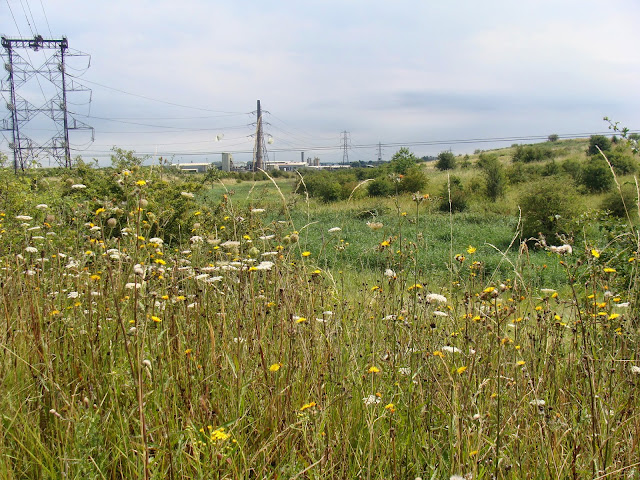
Cooling Marshes, Kent, 7th December 2014
Showing posts with label Planning. Show all posts

Saturday, 12 September 2015

Can you hear the nightingales sing? (Part 3)

It had all gone quiet on the Lodge Hill front recently...until this headline rather came out of nowhere yesterday:


The BBC reported on it here and Miles King provided this interesting blog on the news.

Too early to celebrate? Perhaps, but this is certainly a welcome development in the saga.
"We have recognised a loss of £11.3m due to increased uncertainty over the recoverability of our costs to date following the disappointing decision by the Secretary of State to call in the proposed scheme for public inquiry"
I'm not sure what they've spent £11.3 million on so far but with an experienced developer like Land Securities releasing a quote like this, who would want to step up in their place?

Lodge Hill has been shown time and again to be a site of unique value for wildlife on a local and national scale. It's time that the MOD ceased this reckless pursuit and perhaps took a look at the positive steps taken by the German government with regards former military bases. Similarly, Medway Council needs to take this opportunity to re-evaluate their planning strategy. Chattenden is not the place for a development on this scale, it's time to move on.

Thursday, 6 November 2014

Swanscombe Peninsular plans revealed

I went to the latest round of community consultations for the proposed development of Swanscombe Peninsular last night - the so-called London Paramount 'entertainment resort'. It was pretty interesting.

Being the second round of events there was more information and more detail on show this time, including a map of the site and the outlined planning boundary. Having seen both these now, I stand by my initial concerns.

Proposed London Paramount planning boundary - Nov 2014

This graphic above shows the proposed boundary of the planning application. I was surprised to see such an extensive area of land included south of the main peninsular. This is apparently to cover for likely 'infrastructure works' needed to accommodate the massive amount of people/vehicle traffic predicted. A spur road off the A2 is suggested. Note several large arable fields are included south of the A2 section.

I found it amusing that by way of introducing this consultation, London Paramount chose to include a panel acknowledging the 'History of Pleasure Gardens' and the subsequent "explosion of interest in the Thames as a leisure source". Included were several sepia photographs of piers and beach huts from locations along the river many, many years ago. So I guess what they're really trying to say is that these kind of these things are part of our cultural heritage anyway and who are we to deny that? "In many ways, pleasure gardens were the amusement parks of Georgian England!". I added the exclamation mark, it felt like it needed one.

There was more information this time on the environmental issues which was good to see. Their aspiration is for the resort to be "heralded as setting a new standard for environmentalism" and to "maximise the role of the river and the wonderful marshes surrounding the site". I like the latter line much more than the meaningless first part. There was mention of education opportunities, SUDS and "biodiverse green roofs", that means 'green roofs' - the word 'biodiversity' was used pretty liberally for my liking.

Here is the 'masterplan' for Swanscombe Peninsular as it stands:


So Black Duck Marsh, Broadness and (half of) Botany Marsh have been spared. However it in no way makes up for the fact that the orange monstrosity in the middle is going to have a huge impact on the ability of the site's wild flora and fauna to thrive and will irrevocably alter the sites open character. Given that when questioned, I received a pretty evasive answer about the area marked for 'Possible Future Expansion' (it would remain untouched at point of opening) it seems inevitable in this plan that the site's habitats will be diced up and fragmented with no thought to connectivity. In the first consultation I was told "we'd be stupid to build right up to the river" and yet this plan comes pretty close to achieving that, never mind that it looks like the jetty roost will disappear to make way for a new river taxi/ferry terminal. With 15 million annual visitors (!) predicted and all the subsequent noise, light pollution and disturbance, how do you think the wildlife on site will fare?

What we'd lose most here is another expansive sweep of North Kent's marshes. Ignore the 'brownfield' tag, to me, sites like this are the essence of  a modern wilderness; it's an open space, forgotten by industry (and most people) but taken on by nature. London Paramount describe the site as "isolated by its previous industrial uses" and an ITV news article called it "pretty much derelict" - interesting choice of phrases here. No human use, therefore no value.

You can stamp 'biodiversity' on a million pieces of paper and you will never recreate sites like this; so unusual and exciting and filled with a sense of recovery. It is early days and I look forward to seeing how plans develop.

Swanscombe Marshes, June 2014 (photo taken from within the proposed orange 'leisure area') - read my blog about it here:


If you get a chance to go to the current presentations - the dates and locations are here. Please do. Alternatively you can write to London Paramount here. All comments welcome below too.

Even better - why not pay the site a visit? It's great. Here are some recent bird sightings (thanks RK):

Bearded Tit, Shoveler, Gadwall, Teal, Snipe, Little Egret, Marsh Harrier, Reed Bunting (7), Stonechat, Cett's Warbler, Water Rail

Thursday, 11 September 2014

The last song for Lodge Hill?

Part of Lodge Hill and Chattenden Woods, Hoo Peninsular, Kent, 2013

I didn’t sleep much last Thursday night. This came as a result of flicking through twitter in the evening and reading the news that Medway Council have approved the controversial Lodge Hill development on the Hoo Peninsular, near where I live. The plan is for a 5000 unit, new town development in the middle of a SSSI site. I stared at it, my temperature rising, utterly shocked at the decision.

The timing was surely no coincidence – with local communities and campaigners far and wide (not to mention national and local media) largely distracted by the government's Airports Commission result and the fate of a hub airport in the Thames estuary due two days before it. After that positive outcome and the widespread relief that followed, this feels like a case of one step forward, two back.

I've written about Lodge Hill and Chattenden Woods before. It is, in short, a remarkable place; for birds – including the Nightingale, a beautifully subtle woodland blur, but a bird that yells it's secret with unparalleled melody and power. It is a protected and rapidly declining migrant species (a 60% decline in just c15 years between 1995 and 2009, BTO) which breeds on the site and the close vicinity in nationally significant numbers (84 pairs, BTO, 2012). It is a site full of rare and interesting invertebrates thriving in a range of habitats. It has archaeological importance and tracts of grassland that are difficult to describe but seldom seen elsewhere in the area!

Now picture a warm summer's evening at Lodge Hill, some time in the future; dozy moths flit beneath the soft lights of a Tesco Metro, the scent of fried chicken catches the breeze and 10,000 cats defecate on patchy lawns thinking about what bird they might eat next. Ok, maybe I'm exaggerating...but what happens to everything I mentioned above?

The answer is apparently 'offsetting' the nightingales to a remote part of the Essex coast - creating habitat in the hope (and only hope) that they come. For all the talk and proposals written, a nightingale's behaviour can't be predicted on this scale - at any rate, the pressure placed on them in the meantime would most likely break an already fragile population. It is no coincidence that these birds have made their home here. As for everything else? Well, plans include a nice, managed country park for them.

It’s not always just about the headline acts though; the Lodge Hill and Chattenden Woods complex supports a vast array of common or locally scarce species, all of which have a place in our local natural heritage. What struck me, when talking this news through with my Dad, was that it wasn’t the impact on the nightingales or the scrub or all the brilliant insects that I recalled until later. What came immediately to mind was the impact the potential development would have on a wider environmental scale. The area upon which Lodge Hill lies could be seen as the cornerstone of a landscape that, bar the blinking lights of the power station at Grain and its associated industries, is still largely dominated by small, rural settlements and farming. The plans to stick a new town in the middle of it, and ride rough shod over a government-approved environmental designation, will irrevocably alter one of the last tracts of wild, open land in the South East. The consequences of this will be felt by many and creep far beyond the edge the wood, down to the estuary shores and continue across much of the country.

The view from the top - a sensitive landscape
Peacock butterfly (Inachis io) sunning itself in a Chattenden Wood ride, April 2013

Despite feeling exhausted, Friday worked out well in the end. It was good to be busy so as not to think too much about all this. And when I finally did start to look at my phone again I could see things happening, there were angry tweets, passionate blogs, media reports and messages from friends. It was great.

Sitting on the train home in the evening, looking for a distraction, I got round to finishing 'Cider with Rosie'. I can't quite believe it's taken me so long to read it but I'm glad I have - it's an absolute joy. I plodded through but only because I couldn't help but savour Laurie Lee's words; I read some passages over and over again throughout, with vivid pictures forming in my imagination. It was perhaps fitting that my journey should include the last chapter. Here he recalls the dramatic changes taking place in his small village in the late 1920's, a gathering of pace that led him to write "I belonged to that generation which saw, by chance, the end of a thousand years' life". Those words stuck to me.

For Medway Council to brand this development as "sustainable" is either a downright lie or exposes a frightening and twisted cynicism, born from a shocking lack of responsibility and understanding. I don't suppose the blame for this decision can fall squarely on Medway Council, I would imagine they have been placed under great pressure from the developers, Land Securities, who are looking to boost their strategic south eastern 'portfolio' in the wake of the Ebbsfleet 'Garden City' reprise. Internal influences no doubt played a part too.

Medway and North Kent has been blessed with many wonderful sites of national natural importance - Lodge Hill is right up there. Those in power, the decision makers, have a responsibility to all of us to recognise this. It is a site which confounds and amazes and to knowingly erase it, depriving future generations of a chance to discover something so unique, would be tragic.

Thankfully, it's not over yet, there is a still a chance and that's better than none -

Please help by urging Eric Pickles, Secretary of State, to 'call in' this decision and stop the development.

(Also check out the RSPB website for updates and Miles King's excellent blog for reports on Lodge Hill and a range of issues)

Let's hope that this isn't an encore and come next April, the April after that, and all the April's to come, the rides and scrubby copses of this incredible site will continue to ring to the sound of something irreplaceable...

Nightingale singing at Lodge Hill, 20th April 2013:


Thanks for reading (photos by me - feel free to use/share them)

Monday, 14 July 2014

London Paramount: Round 1


The photo above (taken from a display panel)  shows the extent of Swanscombe Marshes as they fan out into the Thames in North Kent. This is the site of a massive development proposal by London Paramount for a vast theme park and entertainment 'resort'. I am thoroughly opposed to this idea on environmental grounds so took the opportunity to attend a public consultation in Greenhithe on Friday. This is just a quick post with a few notes I took but I'm sure I'll mention it again in the future.

The consultation in the British Legion Hall was the usual affair - 6 display panels, a few spokespeople, a table of forms to fill in and a car parking free for all outside. The panels laid out the very basics of the proposal which at this stage mostly amounts to a lot of big numbers:

  •  27000 jobs
  • 2 bn investment
  • 200 new businesses
  • 15-18m visitors annually

And that was it really, other than numerous reminders that this is a project of 'national importance' (it's an NSIP or Nationally Significant Infrastructure Project). The main aim of the consultation was to determine how local people wanted to be consulted. It laid out a 4 stage programme of events, up to next summer, in which we apparently have a chance to make our opinions count. 

Unsurprisingly, there was no mention anywhere of the marshes, so I found one of the few reps present. There was a good turn out and a dozen others were doing the same. The majority were concerned about the traffic and infrastructure implications of the development which is pretty understandable. There was talk of the Thames Crossing and whether the proposed development will have an impact on the decision ("no"). I raised my concerns about the impact on wildlife on the site and the huge loss of green space in an already impoverished area. I was told that the boundary indicated on the map (encompassing the entire site) was not intended to show the full, developed area, rather the 'planning limit' for inspectors. Great, not very reassuring at all. In addition the rep said that "some marshes will remain" and pointed out that they'd be "stupid to build right up to the river". Ok, but on a floodplain? Uh... There was an invite to attend a future session with the ecologists undertaking the EIA at the moment before the thread unravelled with a comment about how land of poor quality could be enhanced? But of course, land doesn't necessarily have to be 'quality' to have ecological value.

And that is the sad thing about Swanscombe Marshes. For the majority it is a waste ground, this Kent Messenger article describes it as "derelict", but that couldn't be further from the truth. The first time I visited the site a couple of years ago, on a curious foray around my local area, I was blown away. I remember smiling to myself at the luck of discovering the site, a scruffy, imperfect oasis, nestled between the river and the miserable suburban sprawl. Wheatears popped up on the odd ruined structures, Cetti's warblers blasted away in reeds sprouting from murky ditches and linnets, skylarks and more flushed from the rank grassy areas. Overlooked and left for nature to do what it does, it is almost certainly full of pleasant surprises and is precisely the kind of site that urban areas need. 

Look at that image above again.

Here are a few more recent ones from July 2013 (thanks to RK):


Recent sightings on Swanscombe marshes include 8 Little egrets, 9 Lapwings (inc some nearly fully grown young), 3 adults & 1 Juvenile Cuckoo, Lesser Whitethroat, Whitethroat’s, Cetti’s, Chiffchaff, numerous Reed Warblers, Skylarks, 5 Herons (2 Juveniles)

 The site also holds Adder and Common Lizard. (Again, thanks to RK for this info)

Despite the ongoing need for jobs, the proposed plans for Swanscombe Marshes show the cynical profiteering at the heart of so much planning policy today along with a dramatic misunderstanding of what is actually needed. Is a theme park, car parks, roads and yet more shopping complexes what this heavily pressurised corner of the country really needs? A development on this scale will impact negatively on tens of thousands of people on both sides of the river. As it stands, it will irrevocably wipe out a local wildlife haven - one that might look derelict but is far from it. 

This article summarises a lot of information, it also points out that one of the main landowners involved is Land Securities - remember them?

More detailed information on the planning application will be available in October.


Monday, 14 April 2014

Can you hear the nightingales sing? (Part 2)

Last year I wrote a blog about Lodge Hill - a miraculous chunk of north Kent's rural landscape on the Hoo Peninsular that is home to the Nightingale, a rare breeding bird - and how it could all disappear.

A year on, some things have changed but one thing hasn't - the developers, Land Securities still want to build 5000 homes on the site. This will equate to a potentially catastrophic loss of wildlife on a local (and national) scale. Medway Council recognised it wasn't right and withdrew their plans, Land Securities on the other hand, simply went away and came back in March this year with revised plans which look remarkably like their first.

Tomorrow is the deadline for the current public consultation, so if you have time, please respond and object to this wholly damaging and inappropriate development.

Why is it important? See this post from 2013

Submitting your opinion is easy - it takes 2 mins (because I've written the answer below!)

- Click here to comment through the Medway planning page:

- Click the button saying you do not have a reference number

- fill in the deets and pick your fave bits from the following, or write your own:

I strongly object to the revised Lodge Hill planning application on the following grounds:

1. Lodge Hill has been recognised as a Site of Special Scientific Interest by Natural England, the government’s expert advisors on the natural environment. This is in recognition of the site’s critical importance for nightingales, a migrant bird greatly declining in the UK. The 2012 BTO survey showed the area to hold 84 pairs of Nightingale – with 69 inside the boundary directly affected by development. This total amounts to 1.3(+)% of the national nightingale population. As such it is likely the single most important breeding site for this bird in Britain.

2. The site has considerable biodiversity value: Bat roosts have been recorded present in 19 structures, with several species of bat foraging on site. The site is likely to be of at least county importance for bats. Populations of great crested newts, toads, lizards, slow worms, grass snakes and adders are present. The site is at least of county importance for reptiles.

3. The cumulative impact of the proposed development has still not been recognised in any form. The revised application hugely underplays the additional infrastructure features needed (roads, drainage, sewerage, power) which will, without question, contribute to further damage of habitats in the area. Likewise, it is entirely inevitable that an influx of people to the area on this scale will have a permanent negative impact on the ecology and rural character of the area as a whole.

I find it absurd and downright disturbing that a site proven to be of significant ecological value on a national scale is being treated in this way. When the plans were proposed initially, little was known about the value of this site. What has now been proven is that this is a unique site for nature in the UK. These plans set a tragic example for children today and the generations to come, on our relationship with the environment. Lodge Hill is a key part of the landscape of North Kent and should be preserved without hesitation for the future prosperity and enjoyment of local people, visitors and wildlife.

For these points and more I remain thoroughly opposed to these plans.

Monday, 22 April 2013

Out on the marshes, up on the hill

I enjoyed a beautiful walk out across the Hoo marshes from RSPB Northward Hill on Saturday, our finest spring day yet. The Bromhey Farm trails were alive with birds and their myriad warblings - Linnet, Whitethroat, Dunnock and Chaffinch all relentlessly competing for air time. Several Lesser whitethroats were showing well and it was fantastic to hear my first Nightingale of the year, its incredible song emanating from an impenetrable thicket, all whirrs, clicks and woop woop woops. The walk to St Mary's Bay and back was largely migrant-free save a couple of Whimbrel dabbing about in the lowtide mud, the odd Swallow getting battered in the northerly headwind and two Willow Warbler flitting through the hedgerows on Decoy Lane. At least one pair of Common Buzzard hung above the hill in display, a trail of rooks following their every move. From the orchard I'm sure I caught a brief snatch of a purring Turtle Dove from somewhere but my search came to nothing. Once upon a time we wouldn't have had to look so hard but that is now the fate of our fastest declining spring migrant. The North Kent marshes remain one of the best places I know to see them so fingers crossed some birds make it back this year. Every year is crucial now.

Back up to the farm I saw the new scrapes are coming on well with Avocets already paying close attention and a pair of Oystercatcher looking comfortable too. All around, Lapwing peeled across the sky. It was great to feel that pulse of spring again, life humming from the depths of the grass up to the wispy clouds.

St Mary's Bay
Willow Warbler (Phylloscopus trochilus)

In the evening I walked up through Great Chattenden Wood, not seeing a single other person. I walked the paths in quiet awe of the place, winding through the bright coppices of Hazel and Ash with the early green shoots of bluebells carpeting the woodland floor between them. I circled round, following the mesh fence that divides the wood but perversely keeps it safe. Or until now at least. This is the old Lodge Hill MOD compound, or a small part of it. Once it was home to soldiers, but in their absence it's now a haven for birds, invertebrates, mammals and plants. In recognition of this importance it was recently awarded SSSI status by Natural England, the government's environmental advisory department. 

Along a ride, by one of the fences, a song rings out crystal clear in the evening stillness - a Nightingale, the headline act in this woodland cavalcade. It's depth of voice, its tonal quality, is to my experience, unrivalled in the bird world. In our world. And this place is where it comes to breed, over thousands of treacherous miles, to raise the next generation; this is its choice and will. But it is more symbolic than superior, with so many riches here. It's a nice moment and I should enjoy this evening and this place, but it's hard when you realise this could all disappear in an instant. 

Chattenden Wood and Lodge Hill SSSI is threatened with a drastic new town development, one of the largest residential proposals in Europe, that will realistically alter this unique place forever. Keep an eye out and tell your friends and if you visit, don't forget to listen out.

Chattenden Wood SSSI, Kent, 20/4/13


Lodge Hill and Rough Shaw from Cooling Common

Sunday, 21 April 2013

Nightingales return to Lodge Hill!


You can't see it here (they're very sneaky!) but this is a Nightingale singing yesterday evening in Chattenden Woods and Lodge Hill SSSI in Kent. Surveys have shown that this is one of the most important sites in the country for this iconic and threatened species but one that could be facing destruction by an insensitive and wholly inappropriate 5000 home development. Please read more about it here.

Can you hear it Medway Council?! Can you hear it Land Securities?!

Wednesday, 27 March 2013

Winter...or spring?

This post was going to be all about Hawfinches. Instead, it's only going to be a little bit about Hawfinches and a bit more about other...stuff. I mean, I guess I'm finding things a little less-than-inspiring at the moment. Winter (or spring) rumbles on and I've yet to see my first Wheatear of the year...it will officially remain winter until then at least.

There's that old stereotype about how Brits love to talk about the weather and it's true; why not, weather is pretty interesting isn't it?! It's certainly relevant at the moment and while the media scaremongering is beyond tiresome, it is tuned into the fact that everybody is thinking 'what the ****?!' It's not that a cold March is that unusual, I'm sure I can recall it snowing in April before now, but the scale and ferocity of these wintry conditions are hard to ignore. The Guardian ran an interesting article yesterday linking this weather to Arctic sea ice loss. It's worth reading - next time you're at the hairdresser's and find the conversation steered towards the weather, you'll be able to drop in some gems. I wonder if there's a positive side to all this, it's a general awakening to the idea of climate change in the mass public consciousness?

The weather seems to have added a particularly morose veneer to the political machine of late too. I shivered at this incredible exchange of words being battered about the blogosphere recently:

"The idea that the countryside should just hang out and hope for the best is wrong, and, as a result, we've got an imbalance. I haven't seen a peewit or a curlew around here for years. I'm clear that wildlife law should be built around management.' 
As if on cue, a sparrowhawk streaks past the kitchen window and scatters his doves, and he nearly spills his coffee in annoyance. Pity the RSPB employee who recently invited him to look through a telescope at a sparrowhawk-‘ The answer was no, I wouldn't like to, seeing as one had just eaten my last goldfinch. People are obsessed with raptors.'"

Who said that? You got it - it was Secretary of State for Defra, Owen Paterson. The weather's not so bad now is it? You can read the article in 'CountryLife' here, it's hilarious, really.

The bleak and icy conditions today may also be apt for what is the first anniversary of the publication of the National Planning Policy Framework. Greg Clark MP, former planning minister, has been singing its praises on his blog : "The NPPF has succeeded in combining development with conservation, national standards with local empowerment...prophecies of an environmental apocalypse have not come to pass. The green belt is still very much in place, containing sprawl and ensuring that England remains green and pleasant." Thinking about my last post, I'm not sure I'd agree with that. Only one year on, this is really just the beginning, there are tough, relentless challenges for the environment ahead. The weather will improve eventually, the spin will stay the same, I just hope that in the rush for the lotion and the bucket and spade, we don't forget everything else.

On a brighter note, I headed out last weekend to see some Hawfinches! If you're a birder living anywhere in the vicinity of London, you will have heard about Mickleham and the incredible flock of finches currently frequenting the area. For birds more typically encountered in small flocks, the 110+ individuals that have been recorded here for the last few weeks is a remarkable occurrence. Whilst resident in the UK, albeit very locally, it seems a flock of this size must be swelled with, if not entirely consist of, continental birds - perhaps pushed into seeking new food sources by the harsh winter?

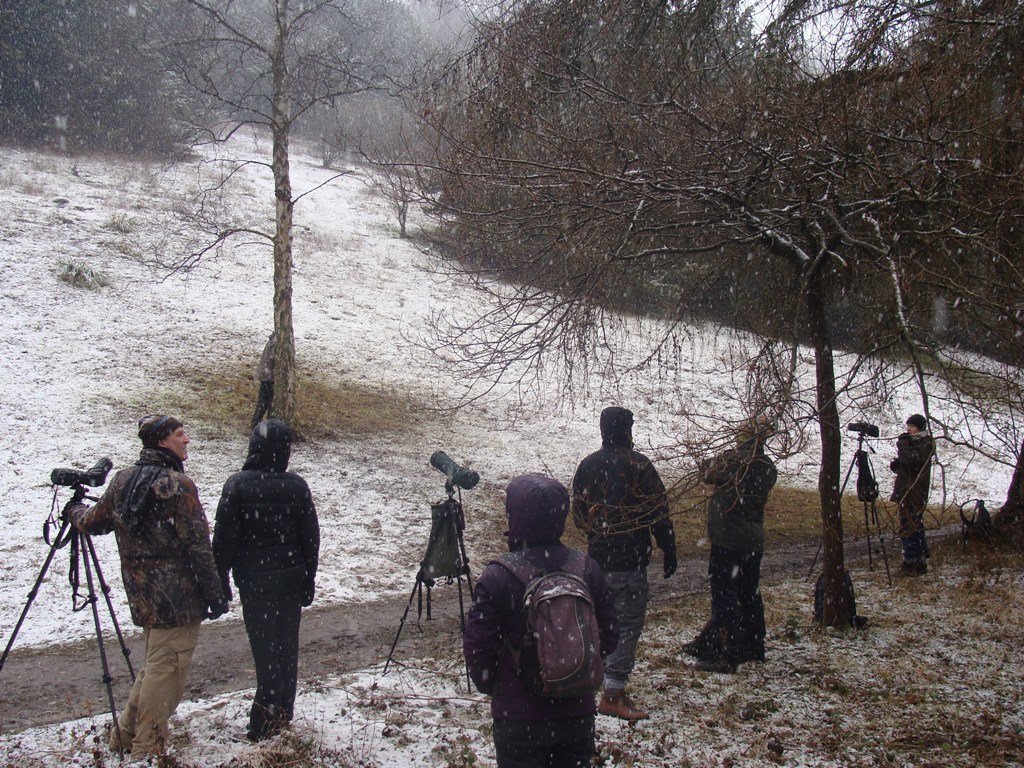
I scraped the ice off my car and headed round the M25 to Surrey on Saturday to have a look. Arriving around 8am in murky conditions, I found the spot at Juniper Bottom, closely followed by two more birders. If there was an upside to the cold and the gently falling snow, it was the stillness and the silence. Snow hung on the trees where nothing moved save tiny hidden voices every now and then. A Tawny Owl shrieked somewhere and a Song Thrush did its admirable best to lift spirits. For an hour an half I walked up and down the track, more in an effort to keep warm than anything, without sign of the birds until eventually I began to pick up some calls in a nearby fir. Another group of birders timed their arrival perfectly because within minutes, a flock of 11 birds suddenly left the shelter of the tree and swirled over our heads, this was followed a moment later by another large flock of c30 birds. Looking up into the sky, in between mouthfuls of sleet, I got decent views of this monster finch and it made the long, cold wait worthwhile. After a burst of activity, the flock disappeared from view and I was left to contemplate the wintery landscape.

Haw frost: Juniper Bottom, Mickleham, Surrey, 23/3/13
Twitching? It's snow joke...classic

Monday, 18 March 2013

Can you hear the Nightingales sing?


In almost exactly a month from now, the first Nightingales to have returned to southern England from their wintering grounds in the lush forests of East Africa will be starting to fill the hawthorn thickets and rides around Lodge Hill and Chattenden Woods on the Hoo Peninsular with their astounding song. But they won’t be aware that the future of the site, one of the single most important locations in the country for a species which nationally declined 60% between 1995 and 2009, hangs in the balance.

For several years now, Lodge Hill has been the subject of a massive new 700ha development by Medway Council and Land Securities; a development amounting to 5000 new homes (the biggest single one in Europe) and countless other amenities being dumped slap bang in the middle of the Hoo Peninsular - a predominantly rural area, rich in wildlife, history and community values. It is a thorughly miserbale concept. But when plans for the development were scrutinised, local conservation groups reacted with the urgency you would expect, going to great lengths to point out the value of this site for nightingales and other wildlife. Their pleas were backed up by the results of the BTO’s 2012 Nightingale survey that showed the area to hold a fantastic 84 pairs of Nightingales, more than previously thought - with 69 inside the boundary directly affected by the development.

Yesterday (Thursday), after many months of hard work behind the scenes, an important decision was made by Natural England. They awarded Lodge Hill SSSI status on account of its important mosaic of habitats, specifically ancient, semi-natural woodland and tracts of neutral (unimproved) grassland and its importance for breeding nightingales. This decision extends the current SSSI boundary of Chattenden Woods, creating a new area of 222ha. This is a great result, it’s the right decision and while it the issue won’t go away overnight, it will now presumably make things much harder for the developers.
“It is an offence for any person intentionally or recklessly to destroy or damage the special features of the SSSI or to disturb any of the fauna”
What’s especially encouraging about this decision is that in October 2012, Natural England initially turned down the chance to notify the contested land as a SSSI “at this stage” on the grounds of “good but incomplete evidence”, referring to an issue with the 1999 national nightingale census. I think this shows a fair and diligent approach to the evidence since presented. If Land Securities and Medway Council were concerned by the open-ended nature of this initial statement (and they were) it would have been interesting to be in their offices yesterday don’t you think?!

On the BBC News last night Councillor Jane Chitty, overseeing Strategic Development and Economic Growth in Medway, lamented those pesky nightingales, moaning “is the priority to protect 80 nightingales or is it more important to provide housing?”. That may be a laughably cynical attempt at riling up public feeling ('it's only a few birds') but what she’s missing here is that this isn’t really about 80 nightingales at all, it’s about all those next year and the year after, securing the future of one the most important sites for the species in England. As the designation states, it’s about recognising important habitats, preserving those invertebrate-rich grasslands and so much more. It’s not a case of ‘Birds v Houses’ as the media wants to sell it, the right to provide homes is not being denied; it’s about respect for the environment, logic and protecting something that can't be replaced - a site we should be proud of. 

I don’t think there is any mitigation that can adequately account for Lodge Hill - despite a ‘biodiversity offsetting’ (shudder) scoping report in November 2012 suggesting it is ‘technically feasible’ to adequately offset expected losses to nightingale populations with habitat elsewhere. The amount of habitat required was cautiously suggested by BTO experts to amount to 300-400ha, assuming certain key habitat conditions were in place (!) That’s a lot of land for Kent - meaning lots of smaller sites scattered across the county, many requiring a lot of work (and time) to make them suitable. Do you think offsetting on this scale could work? Perhaps it might on a smaller scale in some situations, but surely the RISK here just too great to mess with? There is clearly something very important about this site to this particular species - what if it doesn't work? 

As I understand, Medway Council and Land Securities now have 4 months to challenge the decision and they will no doubt have been preparing for this outcome so I guess we shouldn’t pop the champagne corks just yet. Personally I'm sick of seeing our countryside filled in by lazy developments and the thought of seeing a whole new town of characterless, unsustainable and over-priced homes, makes me angry; but I’m not blind to the fact that we’re all living too long and we need new places to live. Of course there are other sites where you can build more houses in Medway if you must, without depriving future generations of an important, iconic part of their natural heritage. Lodge Hill may have looked like an easy option, brownfield, picturesque, commutable, but it’s time for a more constructive, sensitive plan B now – leave Lodge Hill to those ’80’ nightingales and all the other little wonders that call it home.

Nightingale (Luscinia megarhynchos)
Source: 
Andreas Eichler [CC-BY-SA-3.0 (http://creativecommons.org/licenses/by-sa/3.0)], via Wikimedia Commons