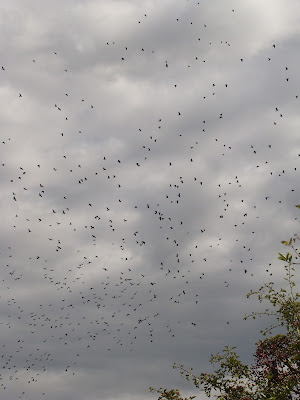
Cooling Marshes, Kent, 7th December 2014
Showing posts with label autumn. Show all posts

Tuesday, 27 October 2015

Chaffinch Appreciation

Had a hard day? I expect it wasn't as tough as the ones these guys had:


I thought I would share this footage which I saw posted earlier today by the BTO, showing a huge number of migrating birds, predominantly chaffinches and brambling, stopping to rest on a research ship in the Baltic Sea this month. Illuminated by the spotlights it looks like a snowstorm blowing across the deck.

It's an incredible, moving scene, in every sense; the darkness, the noise, the random factor (the passing vessel), above all - the primal instinct to survive at all costs laid bare. Following this crossing, many of these birds may have continued over the North Sea to Britain to make the most of our temperate winter. Maybe they're in your garden right now?

Colourful, chirpy and living dangerously. Ladies and gentlemen, the humble chaffinch.


The graph above shows peak counts of chaffinch numbers per week on my patch so far in 2015 courtsesy of BirdTrack. (I didn't visit between mid-March and late July but numbers would certainly have continued in the form of weeks 8 and 9). The annual spike between weeks 40 and 43 is a result of the arrival into North Kent of birds like those above.

Tuesday, 16 June 2015

Autumn in June

Yesterday evening I walked out over the salt lake, its vast edges now a smooth surface dusted with salt crystals, in places it cracked under my feet like a freshly baked cake. A few rubbery plants still poked through here and there in remarkable defiance of the conditions. A few weeks ago the water would have been past my ankles here but the unrelenting heat and wind has drawn the lake backwards to a remarkable degree, a hundred metres or more, so far that birds disappear easily into an oily haze and counting them would be impossible any other way.

Under a glaring sun a few Black-winged stilts headed my way shrieking in alarm and way beyond them a rippling off-white smear over the lake marked the massed ranks of greater flamingos - one thousand three hundred and forty two of them I recorded a little while later.

That the water retreats so much is not surprising given the heat now, but I have also found that Akrotiri is one of the windiest places I have ever been. The peninsula, a thumb of land welded from sand, mud, shingle and sun-scorched rocks, seems barely an inconvenience to the Mediterranean and its prevailing winds pass across as if it were not there.

Other little changes have slowly revealed themselves. I first noticed it last week when those same winds materialised a common tern on the salt lake from somewhere, a bird far scarcer here than in North Western Europe. The same evening, a large roost of adult yellow-legged gulls appeared and set about causing consternation in the kentish plover colony. But yesterday a check on the kentish plovers in the gravel pits also sent a pair of green sandpipers noisily airbound. Unlike the plovers, their breeding range lies much further north so it seems these birds were already headed south – an indicator that migration has started again and the avian calendar has already turned a new leaf in its seasonal spread.

Monday, 3 November 2014

Egypt Bay and Northward Hill 1/11/14


Out there on the marsh, beneath the hill already ominously shadowed by the last minutes of light in the day, comes one of nature’s grandest curtain calls. It is a smattering at first, of lone cries and polite applause, before the sky turns a shade darker than dusk with the sight of a mob approaching. Dressed impeccably and quite perceptibly in black, the rooks are returning to roost.

The noise is incredible and it feels like the whole landscape of the Hoo Peninsula trembles with it. In the bushes some blackbirds shriek and a tawny owl hoots nearby, but all else is indecipherable. On the marsh, after a bright autumn day spent probing the lumpy, grazed turf, the sound is a quarrel; overhead it becomes a glorious riot. The birds stream in in their hundreds. In the glowing dusk their shapes swarm together before they slowly descend into the hill and the trees there become full of it. In the dark, amid the flash of wings and the endless cries, it would be easy to think that chaos reigns. But they know exactly what they’re doing; they've been doing it for centuries.


Rooks at Northward Hill, 1/11/14


The rooks were the final act of a good day out at Egypt Bay and St Mary’s on Saturday. The walk out from Swigshole brought a pair of stonechat, a green woodpecker and numerous blackbirds and chaffinches in the track-side bushes. At Egypt Bay I checked out the workings for the planned breaching nearby and found a colour-ringed adult lesser black-backed gull already settled in. Unfortunately its details were too far to read. On the river was a pair of great crested grebes while the swathes of exposed mud held an assortment of waders and wildfowl. There were small numbers of wigeon and shelduck along with many curlew and dunlin. Crossing over the water from Coryton, I picked out a bird moving fast and low with pointed wings which, banking into the light, turned out to be a kestrel. Nearby, I watched a small flock of knot feed hungrily alongside some watchful grey plovers. I was surprised to see several butterflies still on the wing, including a small tortoiseshell and several clouded yellows - the latter clinging to dandelions in a final, defiant grip of summer. The highlight of the afternoon however was a female merlin perched on a fence post briefly before taking off and having a swipe at a meadow pipit. It missed, but like the rooks and all the rest, it played its part on a truly epic stage.


There ain't no mud like estuary mud: Wigeon near Egypt Bay
Brent Geese over St Mary's Bay

Links:

Thursday, 3 July 2014

Mr Happy

I wish I'd taken my camera out tonight, the fields looked majestic in the sunset. But a camera wouldn't have done any justice in truth; no strong scent of honeysuckle as it laces up the hedgerow nor the warmth emanating from the feint and dizzy heads of wheat. The occasional clanking of the sprinklers straddling the rows of spring onions would instead be replaced with a generic image of modern lowland agriculture today.

There'd be no clip of the dragonflies' wings as it steamed past me and certainly no record of the two yellow wagtails skipping above the now substantially bushy potato field. I lucked on to these birds as I scanned the field idly, actually more engrossed by how previously invisible insects were now catching the light as they darted this way and that, like fireflies. But the birds appeared and darted across my view, alighting on the dark leaves, absolutely golden in that light.

Yellow wagtails don't breed on this site (although I'm sure they do in the wider vicinity) so it seems that autumn has begun. If there was any doubt of that, a minute later two swifts charged through the sky towards me and carried on determinedly past, sailing on, the south calling.

Walking back, a large dog with a glossy coat bounded towards me, closely followed in a less enthusiastic fashion, by an ageing, tall, thin chap in shorts and baggy t-shirt. The shirt was one of those ones with a big, grinning Mr Men character on - in this case, Mr Happy. I didn't suppose he'd bought it himself, but then really, I guess, that's not the point.

Sunday, 3 November 2013

Egypt Bay to St Mary's


Jet streams over the marsh: looking back from Egypt Bay, 2/11/13 

Yesterday I took one of my favourite walks out to Egypt Bay and along to St Mary's. There's nowhere else near home I know that comes close to matching to the sense of space there; in a corner of the country rapidly being filled in and topped up with bad ideas, it's remoteness is priceless.

It was bright and calm as I walked down the lane at Clinch Street, the far side of the river was obscured, all except Southend sea front which caught the light and appeared like an island in the estuary haze. I had owls in mind mostly, a Short-eared perhaps or something nice tucked into the sea wall, like a previously undiscovered flock of Hermit thrushes. Not too much to ask for. As it was, I saw no owls and the tide was way up on the sea wall, nothing stirring amongst the heroic, wind-battered weeds and transient strands of litter there. Well almost nothing, a Small Tortoiseshell butterfly briefly spluttered into flight, making a mockery of a November morning in the process.

Along the track past Swigshole cottage, the usual mix of tits and finches flitted about, a few linnets too. A Great Spotted Woodpecker bolted from a willow at my presence before deciding I was little threat and returning. I noticed the RSPB fields behind Swigshole copse have had heavy plants in recently, digging shallow rills by the look of it; hopefully this will improve an area of grassland that was otherwise pretty poor for wading birds. Further along the track, a pair of Marsh harriers, an adult male and female, grappled together in the air momentarily before drifting apart. Overhead a Rook called oddly, a guttural, Raven-esque croak that, scanning around, revealed a third, much darker harrier moving high to the west.

From the old sea wall at the back of Decoy fleet I heard the distinct ping ping ping sound of Bearded tits in the reeds. I spotted a single bird darting for cover in Decoy until a much nearer series of calls took me to the smaller fleet adjacent to the wall. A flurry of movement low in the reeds revealed a roving flock of five birds, 2 males and 3 females, busy stripping seeds from the spongy reed heads as they went. I watched them for a bit and took some footage that probably won't make it on to 'Autumnwatch' (but listen hard and you might hear them calling):


From the same spot I looked over the marshes. In the field behind Egypt Bay I scanned the bramble clumps as I always do, for shrikes, but as always there were none. Three Stonechats turned up though, one being given a hard time by a slightly out of place Robin - an odd bird to see this far out on the marsh so presumably a hungry migrant fresh in. Along the sea wall a mighty roost of Curlews could be seen between the fleet and St Mary's Bay - a sign that the tide was high. I counted 310 birds, no doubt missing a few unseen. On the river was a raft of three hundred Wigeon while a single Little Egret and several Meadow pipits flushed from the thin lip of salt marsh squeezed against the wall. From the wall I picked out a single Kestrel and a hundred or so Lapwing in the fields but the highlight was undoubtedly two winter-plumaged Red-throated divers which flew slowly up river close in.

Monday, 14 October 2013

Crane spectacular


Prior to a more in depth account of my trip to Cyprus, here is some footage of a spectacular event that I witnessed yesterday evening.

Taking a final stroll on my adopted patch for the week before leaving for the airport, I heard an odd grating sound somewhere in the distance. At first I thought it was a radio or the local restaurant gearing up for another night of karaoke, but then it got louder and sounded more familiar. I scanned each way until I picked out a thin, dark, wispy line on the horizon to the north and watched it drift closer until the line became a large flock of common cranes, circling and calling in the cloudless sky. It took my breath away. After a few minutes the flock drifted south and out to sea in loose formations.

I ran back to get my camera and tell one of the other guys. By the time we returned, the first flock of around 90 birds had disappeared but after a few minutes another flock again appeared from the north, this time around 70-75 birds. As before, they passed overhead, calling and circling somewhat erratically. It seemed miraculous how such large birds could sustain such flight over so many inhospitable miles. I wonder if these birds were en route from breeding grounds in north/eastern Europe to wintering areas in Israel/Middle East? Wherever they were headed, I hope they get there safe.

Migration in full, epic flow...what a privilege to see.

Common Cranes over south eastern Cyprus 13/10/11:


Saturday, 28 September 2013

Lesser Yellowlegs at Cliffe

Lesser Yellowlegs (Tringa flavipes) RSPB Cliffe Pools, 27/9/13

I finally caught up with Cliffe's Lesser Yellowlegs yesterday evening, at the third attempt. Having first ventured out during the peasouper on Tuesday morning, only to find two other birders staring at a thick wall of fog, and managing a frustratingly brief view late on Thursday evening, yesterday it showed well on the second Black Barn pool until around 18.20 when presumably it went to roost.

This bird was a first for me and I was surprised to note just how 'dainty' it was compared to the few Redshanks that were around. The combination of slender yellow legs, fine, dark bill (which I have read described as being approximately equal to its 'head length') and particularly its visibly sharp, attenuated rear end, were all good features in the field where the light was otherwise pretty weak. The number of Ruff on the pool, that ever shape-shifting wader, kept things interesting, the variability of that species amazes me. Still, the american wader was the star of the show, ably supported by the seasonal fare of passage birds, the first Wigeon flocks of autumn and a Barn Owl that hunted with typical grace over the causeways on Thursday.


Tuesday, 10 September 2013

St Mary's Bay


The estuary, looking north towards St Mary's Bay from the top of Decoy Hill, Hoo, Kent

Having worked to some extent over each of the last four weekends, watching in frustration as bushes everywhere seemingly groaned under the weight of scarce migrants, Sunday was a day off that I gladly wrestled free of my diary. As the early weekend showers parted and left a fresh, bright autumn morning, I made an early start and temporarily ditched my plans to head out to east Kent in favour of somewhere closer to home.  

The walk out to St Mary's Bay from High Halstow is one of my favourites. Walking down from the farm at the top of Clinch Street, the view is underrated - looking north the estuary spills into the low ground between Kent and Essex and large, irregular arable fields amble downhill to be met by livestock grazing the marshes below the sea wall. A short way along I stopped and took a detour by the Hill, scattering numerous warblers as I pushed through the dense banks of hawthorn. Common whitethroats and Blackcaps tutted their frustration at being disturbed from their foraging as tits pinged here and there. A male Sparrowhawk sunned itself on a discreet perch before spotting me and bolting off with a loud, repetitive cry. Further down the lane a Willow warbler whistled and swallows buzzed by continuously, a Green woodpecker hugged a telegraph pole.

I took my time along the track at Swigshole to Egypt Bay, checking the bushes on the way. A young Reed warbler that hopped from cover momentarily was probably a local bird. Several Yellow wagtails flew over, their little sneezing calls giving them away. Scanning the fields to the east over Decoy Fleet, bought a large harrier that momentarily confused me as it soared to a great height, but there was no mistaking the male Marsh Harrier as he descended over his kingdom. As I reached the top of the wall overlooking Egpyt Bay, five Red-legged partridges flushed from the beach and thudded past me. The tide at Egypt Bay was lower than I've ever seen it and I fancied I could even wade across to Canvey at a push. But out on the distant tide line, amongst the vast tracts of rich, exposed mud, shapes flicked about and calls passed me on the breeze. Curlews were notable in number, pushing forty easy, it was good to see these birds back for winter.


Heron Meat: St Mary's marsh, south from the sea wall
The London Gateway container port from Egypt Bay, dominating the river.

I love the vantage point that following the seawall from Egypt Bay to St Mary's Bay brings; the river on one side, the marshes on the other. I always remember the misty morning two winters ago that Simon and I found a pair of Shore Lark here. This morning, from the same spot, a Wheatear pops up on the rocks and proceeds to leapfrog down the track ahead of me. In the field, I picked out a Hobby perched conspicuously in the short grass and two kestrels squabbling with each other in the distance. Save for a small group of Black-tailed godwits and some listless Black-headed gulls, St Mary's is empty, so I sat a bit, messing about with some digiscope shots of a Wheatear - probably the same one, as it darted among the debris of the high tide line in the bay.

I continued looking for chats along the access track that runs back south from St Mary's but it was rather quiet until I spotted a small, dark raptor zipping low over the fields to the left. I watched it alight on a distant fence post and, through the scope, discounted hobby and kestrel before clinching a female Merlin in the scope. Great stuff. Moments later I was buzzing again as I caught a brief chat-shaped bird shooting across the field. Scanning the fence posts in the direction of flight I quickly landed on four spanking Whinchats, jostling together on a strand of barbed wire. All lined up like that, the views were great.

Heading back up the lane to complete the circuit, my progress was followed by noisy squadrons of rooks overhead. There were a thousand and more, shifting this way and that; and it occurred to me that perhaps this more than anything else that morning, reminded me that autumn is here again.

Wheatear (Oenanthe oenanthe), St Mary's Bay
Rooks in flight over St Mary's marsh