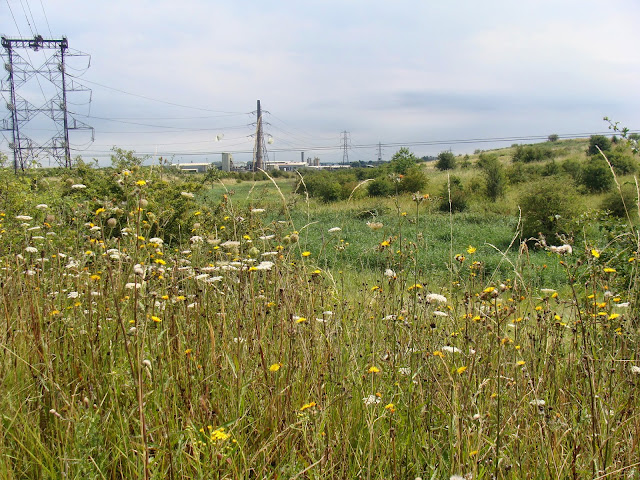
Cooling Marshes, Kent, 7th December 2014

Thursday, 11 December 2014

On the margins of Land and Sea

It was a wonderful weekend just gone, one spent on sparse, sloshing fields stripped of seed, flower or scent, but still full of promise as the seasons reach their ebb.

On Saturday, with a bright winter sky rising, I set off early for East Sheppey, one of my favourite destinations at this time of year. I pondered my plan for the day en route before settling on the usual walk. I crawled along the Harty Ferry Road where the fields were subdued under a heavy frost and little stirred besides a breakfasting kestrel. Past Capel Fleet, house sparrows picked at gutter grit and disappeared into the hedgerows as I passed. Abandoning machine for mind, I soon set out down the track towards Sayes Court looking forward to the day ahead. The copses and hedgerows sparked into life with winter thrushes, woodpecker and finch. Down towards the marsh a hundred and more linnet clung to weedy stems of maize while the first of a dozen stonechats performed nimble aerial feats in a survey of their surroundings.

On the old, grassy seawall I stood somewhere on the margin of land and sea, but safely separated from the realm of water on either side. Small flocks of brent geese flew in off the Swale to join an impressive thousand-strong flock snaking across a distant field like an exposed coal seam. In the small hide I was joined by another birder and between us we traded a Hooded Crow on the marsh for a ring-tail Hen Harrier patrolling a strip of setaside. I quietly admired the handful of White-fronted geese, their tiger-striped flanks, which kept company with the greylags.

Swale NNR, Sheppey; looking west to Shellness
Hooded Crow (Corvus cornix)
Redshank (Tringa totanus), Shellness point

The tide was up at Shellness point where a large mixed flock of waders were packed into the roost, all legs and huddled grey bodies.

At Muswell Manor I walked the track back to Harty as shadows grew ever longer; although not much past lunchtime, the sun's plight was already perceptible. On a fence post a Peregrine flexed its wing before taking off on a lazy swoop at some woodpigeons. Watching its flight I caught sight of another and between the two of them a perfect chaos ensured in the blue skies. Back at the top, sparrows still squabbled in the dirt as I made my way to Capel Fleet. In keeping with the day, the mound was almost deserted. A ringtail Hen Harrier soon appeared quartering a ditch at some distance, before a male ghosted across its path. Ghosted is the word. For in the impeccable winter's light softly falling behind me, teasing each detail, he glowed - all save those inky black wingtips.

Dusk bought the cold back and fingerless glove regret but it was tempered by a fiery evening sky. A woodcock fluttered over and starlings whistled restlessly in the reeds before, in the dim light, two short-eared owls could be seen making silent swoops over the grassland. I squinted after them until even that became too much, the fields merging into one against a blazing sunset.

Hen Harrier by ATM, Shellness
Sunset over Capel Fleet

(Title by JS - thanks, I always liked it)

Thursday, 4 December 2014

Notes from London's 'duck scene'


Apologies for the shameless plug but I thought I'd post a short article I wrote recently for London Wildlife Trust's members magazine 'WildLondon'. The theme of this issue is wetlands and in particular, those sites within an urban setting.

It's no surprise to my mind that I often associate 'urban wetlands', those ponds, park lakes and reservoirs among many others, with people. It seems that these spaces draw people in like few other habitats; they are often natural focal points within these landscapes, admired as much for their openess and ebb as they are feared for their mysterious, cool depths. Our urban wetlands also support a wealth of species and central to their appeal is the more immediate sense of contact with wildlife that they offer, unobstructed and at close quarters. 

Visit any urban wetland and chances are the first thing you'll see are ducks - diving, dabbling or displaying - and that's the subject I was given for this article. I love ducks, who doesn't? As such, a 500-word limit was hard. When I re-read my original draft, I'd spent nearly 100 words describing the pleasingly subtle colours and habits of wigeon. Thanks to the editor then for squeezing the bulk of it in. Thanks also for the amazing sub-title. I bet you didn't know London had a 'duck scene'?!


Thursday, 6 November 2014

Swanscombe Peninsular plans revealed

I went to the latest round of community consultations for the proposed development of Swanscombe Peninsular last night - the so-called London Paramount 'entertainment resort'. It was pretty interesting.

Being the second round of events there was more information and more detail on show this time, including a map of the site and the outlined planning boundary. Having seen both these now, I stand by my initial concerns.

Proposed London Paramount planning boundary - Nov 2014

This graphic above shows the proposed boundary of the planning application. I was surprised to see such an extensive area of land included south of the main peninsular. This is apparently to cover for likely 'infrastructure works' needed to accommodate the massive amount of people/vehicle traffic predicted. A spur road off the A2 is suggested. Note several large arable fields are included south of the A2 section.

I found it amusing that by way of introducing this consultation, London Paramount chose to include a panel acknowledging the 'History of Pleasure Gardens' and the subsequent "explosion of interest in the Thames as a leisure source". Included were several sepia photographs of piers and beach huts from locations along the river many, many years ago. So I guess what they're really trying to say is that these kind of these things are part of our cultural heritage anyway and who are we to deny that? "In many ways, pleasure gardens were the amusement parks of Georgian England!". I added the exclamation mark, it felt like it needed one.

There was more information this time on the environmental issues which was good to see. Their aspiration is for the resort to be "heralded as setting a new standard for environmentalism" and to "maximise the role of the river and the wonderful marshes surrounding the site". I like the latter line much more than the meaningless first part. There was mention of education opportunities, SUDS and "biodiverse green roofs", that means 'green roofs' - the word 'biodiversity' was used pretty liberally for my liking.

Here is the 'masterplan' for Swanscombe Peninsular as it stands:


So Black Duck Marsh, Broadness and (half of) Botany Marsh have been spared. However it in no way makes up for the fact that the orange monstrosity in the middle is going to have a huge impact on the ability of the site's wild flora and fauna to thrive and will irrevocably alter the sites open character. Given that when questioned, I received a pretty evasive answer about the area marked for 'Possible Future Expansion' (it would remain untouched at point of opening) it seems inevitable in this plan that the site's habitats will be diced up and fragmented with no thought to connectivity. In the first consultation I was told "we'd be stupid to build right up to the river" and yet this plan comes pretty close to achieving that, never mind that it looks like the jetty roost will disappear to make way for a new river taxi/ferry terminal. With 15 million annual visitors (!) predicted and all the subsequent noise, light pollution and disturbance, how do you think the wildlife on site will fare?

What we'd lose most here is another expansive sweep of North Kent's marshes. Ignore the 'brownfield' tag, to me, sites like this are the essence of  a modern wilderness; it's an open space, forgotten by industry (and most people) but taken on by nature. London Paramount describe the site as "isolated by its previous industrial uses" and an ITV news article called it "pretty much derelict" - interesting choice of phrases here. No human use, therefore no value.

You can stamp 'biodiversity' on a million pieces of paper and you will never recreate sites like this; so unusual and exciting and filled with a sense of recovery. It is early days and I look forward to seeing how plans develop.

Swanscombe Marshes, June 2014 (photo taken from within the proposed orange 'leisure area') - read my blog about it here:


If you get a chance to go to the current presentations - the dates and locations are here. Please do. Alternatively you can write to London Paramount here. All comments welcome below too.

Even better - why not pay the site a visit? It's great. Here are some recent bird sightings (thanks RK):

Bearded Tit, Shoveler, Gadwall, Teal, Snipe, Little Egret, Marsh Harrier, Reed Bunting (7), Stonechat, Cett's Warbler, Water Rail

Monday, 3 November 2014

Egypt Bay and Northward Hill 1/11/14


Out there on the marsh, beneath the hill already ominously shadowed by the last minutes of light in the day, comes one of nature’s grandest curtain calls. It is a smattering at first, of lone cries and polite applause, before the sky turns a shade darker than dusk with the sight of a mob approaching. Dressed impeccably and quite perceptibly in black, the rooks are returning to roost.

The noise is incredible and it feels like the whole landscape of the Hoo Peninsula trembles with it. In the bushes some blackbirds shriek and a tawny owl hoots nearby, but all else is indecipherable. On the marsh, after a bright autumn day spent probing the lumpy, grazed turf, the sound is a quarrel; overhead it becomes a glorious riot. The birds stream in in their hundreds. In the glowing dusk their shapes swarm together before they slowly descend into the hill and the trees there become full of it. In the dark, amid the flash of wings and the endless cries, it would be easy to think that chaos reigns. But they know exactly what they’re doing; they've been doing it for centuries.


Rooks at Northward Hill, 1/11/14


The rooks were the final act of a good day out at Egypt Bay and St Mary’s on Saturday. The walk out from Swigshole brought a pair of stonechat, a green woodpecker and numerous blackbirds and chaffinches in the track-side bushes. At Egypt Bay I checked out the workings for the planned breaching nearby and found a colour-ringed adult lesser black-backed gull already settled in. Unfortunately its details were too far to read. On the river was a pair of great crested grebes while the swathes of exposed mud held an assortment of waders and wildfowl. There were small numbers of wigeon and shelduck along with many curlew and dunlin. Crossing over the water from Coryton, I picked out a bird moving fast and low with pointed wings which, banking into the light, turned out to be a kestrel. Nearby, I watched a small flock of knot feed hungrily alongside some watchful grey plovers. I was surprised to see several butterflies still on the wing, including a small tortoiseshell and several clouded yellows - the latter clinging to dandelions in a final, defiant grip of summer. The highlight of the afternoon however was a female merlin perched on a fence post briefly before taking off and having a swipe at a meadow pipit. It missed, but like the rooks and all the rest, it played its part on a truly epic stage.


There ain't no mud like estuary mud: Wigeon near Egypt Bay
Brent Geese over St Mary's Bay

Links:

Monday, 27 October 2014

One good Tern...

...deserves a brief blog post.

A few photos of the White-winged Black Tern (Chlidonias leucopterus) at Castle Water near Rye yesterday:


A few ID points here - including the extent of black in the underwing, the white rump and short, almost 'sawn off', rectrices

Despite the gloomy conditions and the bird's initial absence, it soon appeared over its favoured stretch of water and performed well for myself and a fisherman who was interested enough to ask what it was called and why did people keep coming to see it, but otherwise kept his eyes on the water. I'm not a huge fan of suggesting that birds 'perform' for crowds of people, but with that buoyant flight style characteristic of terns, it felt like this vagrant from south eastern Europe was doing its best to impress as it circled us with a determined but still elastic, loping grace. This bird was a first for me, I'd love to see a spring adult one day but this moulting adult was undoubtedly a pleasure to watch.


An interesting article on separating (juvenile) Black and White-winged Black Tern here.

Thursday, 23 October 2014

Crossing the sea to Walberswick

Anyway will do

Sunday morning picked up where Saturday night left of, with the ominous din of gunfire spoiling the peace of the Suffolk countryside. That we’d night we’d stood in a darkened field on our way back from the pub, amazed and fearful of the sounds we could hear in the distance and even more so by the flashes of light on the horizon. We decided it must be a military training exercise but felt unsure that we could fully separate it from what are often described as ‘traditional’ countryside pursuits.

The next day the sounds continued and grated on my nerves as we met a footpath that would take us a few miles to Walberswick on the coast. The countryside shouldn't sound like this; at first, no amount of trees could mask it, but gradually the further we went, the further we got from it and the balance of things returned.

Marking the start of our path was a small carved stone, nestling in the grass. Despite being a little weathered, the shape of a nightjar was visible on it, cool, grey and unseasonal - a marker that indicated the heathland we could see through the thin, silvery lines of birch around us. This birch, the graceful pioneer of such places, soon gave way to a mixed woodland patched together from birch, beech, oak and hornbeam. Underneath this canopy, now receding with the season, dark, musty pools gathered throughout; tackled on tiptoe (and via an ageing boardwalk) pale, decaying leaves could be seen glinting up from their depths like pennies in a well. But soon the oaks won out and the ground became drier, offering up a selection of interesting fungi.


The woods were quiet and still save for the occasional whistles of passing tit flocks. A short way further along the scene changed again and from the wooded path we reached a broad ocean of reeds lapping at the sides of the extensive Westwood Marshes. Like opening a door from one room to another, it was the noise that reached me first, of the wind and the bristling, slender heads of phragmites. A marsh harrier appeared in the distance effortlessly caressing the reeds, a buzzard dropped out of the blue sky and several bearded tits pinged nearby. We followed the snaking path through and continued until we reached a grassy bank in the middle that propped up a crumbling, redbrick windmill submerged and adrift like an old wreck. Once upon a time, such a structure would have played a key role in this landscape, pumping the water out and allowing people in. Now though, it’s little more than a grand perch for keen-eyed predators and for us, a point at which to marvel in our surroundings.

Westwood Marshes/Walberswick National Nature Reserve, 19/10/14