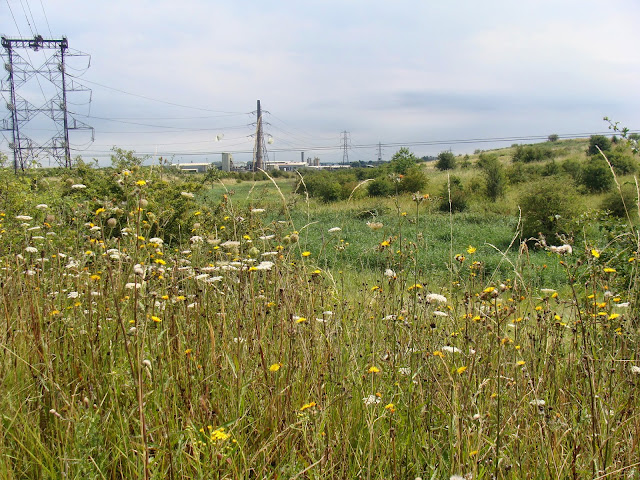
Cooling Marshes, Kent, 7th December 2014

Wednesday, 31 December 2014

A year on the patch

Rather than a typical 'end of year' type blog post, I thought I'd write about life on my patch this year - essentially an unremarkable scrap of land in North Kent, but one that has provided me with genuine moments of awe and discovery in 2014. There have been fragments of encounters that in any other situation or place might be taken for granted or overlooked altogether, but in these fields, close to home, mean a lot more.

I have regularly used the BTO's 'BirdTrack' for a few years now but this year I made an extra effort to record all my patch visits over the two kilometre squares it incorporates and I have enjoyed looking back at the statistics. Here's how Song Thrush records fared this year for instance, any idea when autumn migration kicked in?!


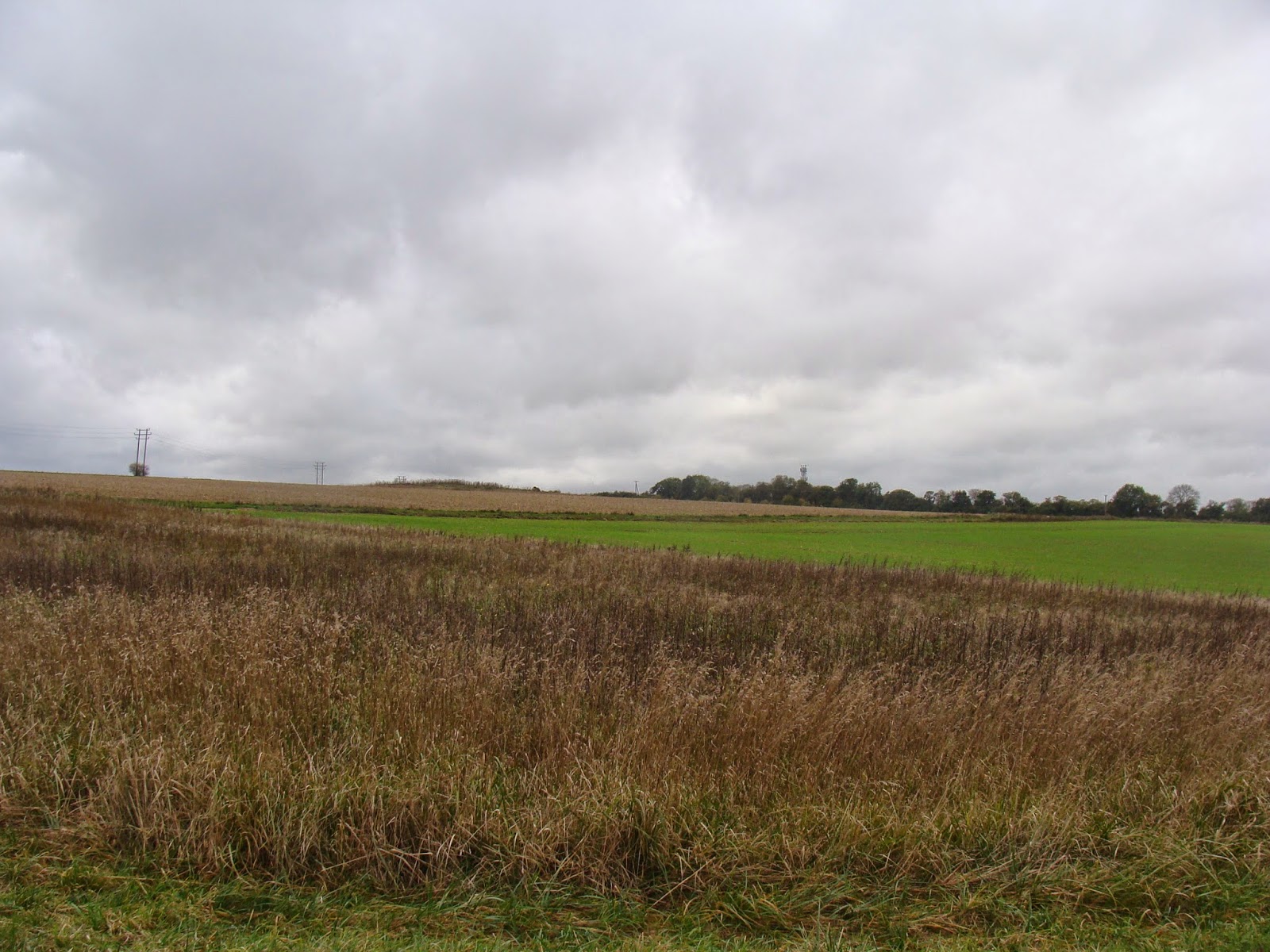
What I often refer to as my 'patch' in Longfield, most other locals probably refer to as 'the Gallops'. As a kid that's what my parents called it so we followed (slightly confused by the horse reference given that we never saw any horses up there), but it's a name that has always stuck. I now know the reason for it, some learning that has unfolded over time through snippets of conversation and a chance encounter.

Over the years I have come to love it, despite it appearing to possess little birdwatching or natural history potential; there is not a drop of water in sight and it is a good few miles from the coast, it has poor diversity of vegetation beyond a small copse, a few hedgerows and some grassy verges. And yet I still visit regularly. It is still farmland thankfully, largely resisting the dirty hands of developers in North Kent, lowland, arable with a fondness for spring onions and potatoes. But it has space on side, open fields and elevation, sitting as it does on a chalk ridge, like the North Downs a few miles to the south. Looking north I can see the River Thames marked only by the grey industry of Northfleet and Tilbury hunched and crowded on its shores: cranes, shapeless buildings and, in recent years, wind turbines on the horizon.

But now I realise that to call it unremarkable is wrong, because it's ultimately not what a local patch is about. It is as much about those small discoveries, those common birds, as it is anything else. Through the familiarity gained, what I've loved most is observing how wildlife uses the site, and more than anything, how it changes through the seasons, as sure as a calender turns a page. By those standards, this year was a great year on the patch.

Linnet, April
Common Buzzard, February
Stonechat, October

As usual there were few surprises through last winter with just a small wintering flock of meadow pipits and occasional glimpses of the corn bunting flock of any note. The year's sole treecreeper record came in February along the edge of Court Wood and the first buzzard appeared, it was a good year for sightings of these. Spring arrived on the 14th April in the ever-heartening form of male wheatear that flushed out from a field edge; the same day the first pair of swallows streamed overhead and a blackcap was singing in the copse. A few days later, on the nineteenth, whitethroats had returned and were spread widely throughout the hedges for a week or more until only those on territories remained. Two spring highlights followed soon after with my first patch Lesser Whitethroat singing in the top hedge on the the 26th. On the 2nd June, a late-evening walk bought the surreal yet triumphant sight of an adult Mediterranean Gull drifting low across the fields towards the village. I nearly dismissed it at first before I remembered that even Black-headed gulls are not overly common at that time of year and checked again.

June saw bright skies and buzzing migrants, including a Cuckoo calling in the first week during my second BBS survey of the season. Yellow wagtails slipped through before becoming more conspicuous from the first week of July, the first appearing on the same date that two swifts headed determinedly south. A juvenile in the vicinity was particularly interesting. House sparrows are absent on the site for much of the year but small flocks venture out in summer, foraging along the magic hedgerow and often in the crops - a flock of twenty was good to see. If I had a single highlight this year it probably came in late-July, into August, as the corn bunting flock swelled to over 70 birds. With such troubling declines elsewhere this was incredible to see and an immensely satisfying result for the simple wildlife-friendly measures employed by the farmer (whether he realises it or not!)

Such measures, including leaving long grassy margins along the tracks, also encouraged butterflies and the summer months saw plenty of activity with a dozen species recorded in good numbers. At the same time, the chalky soil yielded new surprises like yellow rattle, while sweet, pink sainfoin peeped from beneath the stubble.

It was the best year yet for passage wheatears and the first outgoing bird appeared on the 29th July, followed by small numbers (including a flock of 7) through August and the last on 15th October.

Corn buntings and house martins on a magic evening, August
A Painted Lady on thistles, June
Wheatears on their way, August
Looking east, July

The first signs of autumn were visible in August with a light passage of rooks to the west and the wheat harvest ongoing from late-July. There was time for a last hurrah with another patch first - a Hobby performing acrobatics over Court Wood on 3rd September. On the 9th, following widespread passage across the region, up to five whinchats stayed for a week, making use of some weedy setaside established in the last few years. It seemed like a good year for them. The same day saw the first meadow pipits of autumn, followed a day later by two chiffchaffs. On the 17th, a flock of 36 Jackdaw flew north and blackbirds had noticeably increased, but the undoubted highlight was a first Grey Wagtail in the dump briefly. Spring onion picking continued through September and the potato harvest started mid-month.

Following reports of migrant thrushes arriving in number on the east coast with favourable winds on the 15th October, a late-night patch visit resulted in numerous redwings and a few blackbirds being heard flying overhead in the dark! The passage continued into the next morning where several small flocks of redwing could be seen flying over. The most remarkable tally however was for song thrushes (see above) with nearly 50 migrant birds recorded across the site in 2 days. The 15th October also saw perhaps the biggest patch score of the year. A local birdwatcher had reported seeing flocks of Brent Geese flying up the Thames at Gravesend before diverting inland on a south westerly trajectory. Drawing a mental map it seemed that would take them pretty close to Longfield and lo, a flock of ten passed along the ridge that same morning! That was a dizzy morning, I nearly missed my train to work!

Since then, bar another thrush movement in early December which included a scarce Mistle Thrush and Fieldfare, recent weeks have seen the inevitable winter lull set in. But I guess a lull is never a lull for long, it soon becomes a beginning once again.

In total I recorded 68 bird species on the patch this year - not bad for a few fields...

Happy New Year all - thanks for reading.

Little Owl at dusk

Monday, 29 December 2014

Standard Fare

Walking down a quiet lane yesterday I spotted a row of limp, straggly fruit trees on the verge, all bare save one. It's branches were heavy with baubles of spongy, pale crab apples. I instinctively reached for my binoculars. At this time of year our landscapes can feel devoid of colour or life, but find the food and chances are you'll find the birds. 

And there it was, a lone Fieldfare perched among its jewels, one eye on me and one on its precious hoard.


Thursday, 11 December 2014

On the margins of Land and Sea

It was a wonderful weekend just gone, one spent on sparse, sloshing fields stripped of seed, flower or scent, but still full of promise as the seasons reach their ebb.

On Saturday, with a bright winter sky rising, I set off early for East Sheppey, one of my favourite destinations at this time of year. I pondered my plan for the day en route before settling on the usual walk. I crawled along the Harty Ferry Road where the fields were subdued under a heavy frost and little stirred besides a breakfasting kestrel. Past Capel Fleet, house sparrows picked at gutter grit and disappeared into the hedgerows as I passed. Abandoning machine for mind, I soon set out down the track towards Sayes Court looking forward to the day ahead. The copses and hedgerows sparked into life with winter thrushes, woodpecker and finch. Down towards the marsh a hundred and more linnet clung to weedy stems of maize while the first of a dozen stonechats performed nimble aerial feats in a survey of their surroundings.

On the old, grassy seawall I stood somewhere on the margin of land and sea, but safely separated from the realm of water on either side. Small flocks of brent geese flew in off the Swale to join an impressive thousand-strong flock snaking across a distant field like an exposed coal seam. In the small hide I was joined by another birder and between us we traded a Hooded Crow on the marsh for a ring-tail Hen Harrier patrolling a strip of setaside. I quietly admired the handful of White-fronted geese, their tiger-striped flanks, which kept company with the greylags.

Swale NNR, Sheppey; looking west to Shellness
Hooded Crow (Corvus cornix)
Redshank (Tringa totanus), Shellness point

The tide was up at Shellness point where a large mixed flock of waders were packed into the roost, all legs and huddled grey bodies.

At Muswell Manor I walked the track back to Harty as shadows grew ever longer; although not much past lunchtime, the sun's plight was already perceptible. On a fence post a Peregrine flexed its wing before taking off on a lazy swoop at some woodpigeons. Watching its flight I caught sight of another and between the two of them a perfect chaos ensured in the blue skies. Back at the top, sparrows still squabbled in the dirt as I made my way to Capel Fleet. In keeping with the day, the mound was almost deserted. A ringtail Hen Harrier soon appeared quartering a ditch at some distance, before a male ghosted across its path. Ghosted is the word. For in the impeccable winter's light softly falling behind me, teasing each detail, he glowed - all save those inky black wingtips.

Dusk bought the cold back and fingerless glove regret but it was tempered by a fiery evening sky. A woodcock fluttered over and starlings whistled restlessly in the reeds before, in the dim light, two short-eared owls could be seen making silent swoops over the grassland. I squinted after them until even that became too much, the fields merging into one against a blazing sunset.

Hen Harrier by ATM, Shellness
Sunset over Capel Fleet

(Title by JS - thanks, I always liked it)

Thursday, 4 December 2014

Notes from London's 'duck scene'


Apologies for the shameless plug but I thought I'd post a short article I wrote recently for London Wildlife Trust's members magazine 'WildLondon'. The theme of this issue is wetlands and in particular, those sites within an urban setting.

It's no surprise to my mind that I often associate 'urban wetlands', those ponds, park lakes and reservoirs among many others, with people. It seems that these spaces draw people in like few other habitats; they are often natural focal points within these landscapes, admired as much for their openess and ebb as they are feared for their mysterious, cool depths. Our urban wetlands also support a wealth of species and central to their appeal is the more immediate sense of contact with wildlife that they offer, unobstructed and at close quarters. 

Visit any urban wetland and chances are the first thing you'll see are ducks - diving, dabbling or displaying - and that's the subject I was given for this article. I love ducks, who doesn't? As such, a 500-word limit was hard. When I re-read my original draft, I'd spent nearly 100 words describing the pleasingly subtle colours and habits of wigeon. Thanks to the editor then for squeezing the bulk of it in. Thanks also for the amazing sub-title. I bet you didn't know London had a 'duck scene'?!


Thursday, 6 November 2014

Swanscombe Peninsular plans revealed

I went to the latest round of community consultations for the proposed development of Swanscombe Peninsular last night - the so-called London Paramount 'entertainment resort'. It was pretty interesting.

Being the second round of events there was more information and more detail on show this time, including a map of the site and the outlined planning boundary. Having seen both these now, I stand by my initial concerns.

Proposed London Paramount planning boundary - Nov 2014

This graphic above shows the proposed boundary of the planning application. I was surprised to see such an extensive area of land included south of the main peninsular. This is apparently to cover for likely 'infrastructure works' needed to accommodate the massive amount of people/vehicle traffic predicted. A spur road off the A2 is suggested. Note several large arable fields are included south of the A2 section.

I found it amusing that by way of introducing this consultation, London Paramount chose to include a panel acknowledging the 'History of Pleasure Gardens' and the subsequent "explosion of interest in the Thames as a leisure source". Included were several sepia photographs of piers and beach huts from locations along the river many, many years ago. So I guess what they're really trying to say is that these kind of these things are part of our cultural heritage anyway and who are we to deny that? "In many ways, pleasure gardens were the amusement parks of Georgian England!". I added the exclamation mark, it felt like it needed one.

There was more information this time on the environmental issues which was good to see. Their aspiration is for the resort to be "heralded as setting a new standard for environmentalism" and to "maximise the role of the river and the wonderful marshes surrounding the site". I like the latter line much more than the meaningless first part. There was mention of education opportunities, SUDS and "biodiverse green roofs", that means 'green roofs' - the word 'biodiversity' was used pretty liberally for my liking.

Here is the 'masterplan' for Swanscombe Peninsular as it stands:


So Black Duck Marsh, Broadness and (half of) Botany Marsh have been spared. However it in no way makes up for the fact that the orange monstrosity in the middle is going to have a huge impact on the ability of the site's wild flora and fauna to thrive and will irrevocably alter the sites open character. Given that when questioned, I received a pretty evasive answer about the area marked for 'Possible Future Expansion' (it would remain untouched at point of opening) it seems inevitable in this plan that the site's habitats will be diced up and fragmented with no thought to connectivity. In the first consultation I was told "we'd be stupid to build right up to the river" and yet this plan comes pretty close to achieving that, never mind that it looks like the jetty roost will disappear to make way for a new river taxi/ferry terminal. With 15 million annual visitors (!) predicted and all the subsequent noise, light pollution and disturbance, how do you think the wildlife on site will fare?

What we'd lose most here is another expansive sweep of North Kent's marshes. Ignore the 'brownfield' tag, to me, sites like this are the essence of  a modern wilderness; it's an open space, forgotten by industry (and most people) but taken on by nature. London Paramount describe the site as "isolated by its previous industrial uses" and an ITV news article called it "pretty much derelict" - interesting choice of phrases here. No human use, therefore no value.

You can stamp 'biodiversity' on a million pieces of paper and you will never recreate sites like this; so unusual and exciting and filled with a sense of recovery. It is early days and I look forward to seeing how plans develop.

Swanscombe Marshes, June 2014 (photo taken from within the proposed orange 'leisure area') - read my blog about it here:


If you get a chance to go to the current presentations - the dates and locations are here. Please do. Alternatively you can write to London Paramount here. All comments welcome below too.

Even better - why not pay the site a visit? It's great. Here are some recent bird sightings (thanks RK):

Bearded Tit, Shoveler, Gadwall, Teal, Snipe, Little Egret, Marsh Harrier, Reed Bunting (7), Stonechat, Cett's Warbler, Water Rail

Monday, 3 November 2014

Egypt Bay and Northward Hill 1/11/14


Out there on the marsh, beneath the hill already ominously shadowed by the last minutes of light in the day, comes one of nature’s grandest curtain calls. It is a smattering at first, of lone cries and polite applause, before the sky turns a shade darker than dusk with the sight of a mob approaching. Dressed impeccably and quite perceptibly in black, the rooks are returning to roost.

The noise is incredible and it feels like the whole landscape of the Hoo Peninsula trembles with it. In the bushes some blackbirds shriek and a tawny owl hoots nearby, but all else is indecipherable. On the marsh, after a bright autumn day spent probing the lumpy, grazed turf, the sound is a quarrel; overhead it becomes a glorious riot. The birds stream in in their hundreds. In the glowing dusk their shapes swarm together before they slowly descend into the hill and the trees there become full of it. In the dark, amid the flash of wings and the endless cries, it would be easy to think that chaos reigns. But they know exactly what they’re doing; they've been doing it for centuries.


Rooks at Northward Hill, 1/11/14


The rooks were the final act of a good day out at Egypt Bay and St Mary’s on Saturday. The walk out from Swigshole brought a pair of stonechat, a green woodpecker and numerous blackbirds and chaffinches in the track-side bushes. At Egypt Bay I checked out the workings for the planned breaching nearby and found a colour-ringed adult lesser black-backed gull already settled in. Unfortunately its details were too far to read. On the river was a pair of great crested grebes while the swathes of exposed mud held an assortment of waders and wildfowl. There were small numbers of wigeon and shelduck along with many curlew and dunlin. Crossing over the water from Coryton, I picked out a bird moving fast and low with pointed wings which, banking into the light, turned out to be a kestrel. Nearby, I watched a small flock of knot feed hungrily alongside some watchful grey plovers. I was surprised to see several butterflies still on the wing, including a small tortoiseshell and several clouded yellows - the latter clinging to dandelions in a final, defiant grip of summer. The highlight of the afternoon however was a female merlin perched on a fence post briefly before taking off and having a swipe at a meadow pipit. It missed, but like the rooks and all the rest, it played its part on a truly epic stage.


There ain't no mud like estuary mud: Wigeon near Egypt Bay
Brent Geese over St Mary's Bay

Links: