Cooling Marshes, Kent, 7th December 2014
Showing posts with label Cliffe Pools. Show all posts

Monday, 16 February 2015

The light returning

Estuary sunset. Looking across Cliffe creek to Gravesend and Tilbury.

Out on the marshes the light lasts longer; it travels for miles, through reeds and scrub, across rank fields dotted with grazing livestock, it blazes across the pools, pink, blue and purple.

I made a late visit to Cliffe yesterday, arriving with the mixed throngs of wigeon and lapwing already uttering their restless pre-roost assurances from the causways snaking across the site. From their midst, the barks of noisy greylag geese drifted across the water. The pools were flat calm, so much that a little grebe diving under the surface fifty metres away was more of an event than usual. Not much stirred but I was able to pick out the wintering male scaup among some tufted ducks on radar pool. 

In the peachy dusk cast over Flamingo pool, coots made for their corners and a distant harrier stirred up all manner of squeals as it passed. A pair of goldeneye drifted close by, the resplendent male head bobbing as it went. Wild swans have been scarce in the area this winter so I was pleased to catch up with a party of seven bewick's swans, one of my favourite seasonal migrants, roosting on the beach. Paddling serenely or half-asleep, it's a wonder to think of all the land that will be passing beneath their powerful wings on the journey they'll soon be taking back to Siberia.

From the sea wall I watched the sun's fiery slick across the water meander to nothing as it dropped into some untraceable suburban shadows beyond Gravesend. In its absence, under the clear evening sky, misty patches appeared along the edges of the track like snagged wool on a wire fence. The mist clung low to the damp fields but I could still make out the shapes of harriers drifting in, gliding silently over the reeds, ever lower until they too were gone.

From the track, teal and mallards called in the dim light but above it all rose the formidable shrieks of a song thrush deep within its guarded hawthorn thicket. Although not quite at its peak, a little rusty perhaps, there was no mistaking its sure understanding that the light will soon be returning.  

male Goldeneye (Bucephala clangula), Cliffe Pools, 15/2/15 
Bewick's Swan (Cygnus columbianus bewickii), Cliffe Pools, 15/2/15

Sunday, 28 September 2014

Bucket List

After a busy week, I felt in great need of some wide open space today so I headed to Cliffe and the marshes. I know of few landscapes more soothing to my mind, or more rewarding for the nature-lover than this expanse of estuary and today it delivered on both.

With the heavy morning haze burning off to leave a bright, simmering autumn day, I started in Cliffe church yard amidst a din of whistling starlings. A few goldcrests called from the boundary oaks along with two handsome, fresh chiffchaffs. Several dunnocks peeped and, as I glanced up in the direction of a rattling mistle thrush, two swallows zipped by the tower.

Down on the rspb reserve it wasn't long before I spotted the long-staying, immature spoonbill roosting on one of the ski pool islands. Further scanning brought my first two pintails of the autumn, along with a single ruff and greenshank. The pools were ruled by fleets of coots. With high tide some way off there was little of note on Flamingo - a few more pintails sailed serenely by and dozens of little egrets strutted along the weedy edges, but lapwings were conspicuous once again. Even relatively early in the day, the air was thick with insect life and crane flies and flies of all sorts continually bounced off me. Dragonflies and darters buzzed through the scrub and a clouded yellow butterfly kicked up and charged past me on the track down to the river. The butterflies it seems were enjoying the balmy autumn weather with clouded yellows abundant along the river wall. From a personal perspective, it seems to have been a good year too for wall butterflies and another one lived up to its name today, flitting amongst the grass in the sunny seclusion of the river wall at the Thames View Point.

With only the slightest easterly breeze I expected the river to be quiet, so it was nice to see two juvenile kittiwakes flying up and down mid-channel between passing ships. While watching these my eye fell unexpectedly on the large, dark shape of a juvenile gannet flying low over the water, down river away from me. Walking east along the wall, black-headed gulls and several common gulls made up the throng, hawking high over head  for the insect bounty. At Lower Hope Point, utilising an upturned bucket, I was happy just to sit and watch the river flow for a while. At one point I head a distant, hoarse tern call and managed to pick out a small bird with discreet black head markings mid-river. With a good view difficult due to the haze, a black-headed gull did me a favour by flying along side it and dwarfing my bird in the process - revealing a presumably juvenile little tern.

Plodding on, I passed a family sat quietly on the bank and a fisherman on the saltings doing little more than I had been, minus a bucket. Beyond him I could see birds scurrying back and forth on the sea wall and, edging closer, saw eight of them were stonechats, hurriedly feeding on the swarming flies. They were joined at the banquet by four wheatears and yet more meadow pipits. I could watch wheatears all day long and maybe, because I knew these might be the last ones I see this year, they looked extra smart. Walking back, I met the fisherman again and stopped to ask about his catch. Not good, nothing in fact. He told me how he used to catch cod there years ago but not any more in this part of the estuary. I wondered if this was due to disturbance and the new port development but he thought it was overfishing. He went on to say how he'd been visiting the same stretch of river for 45 years and some of the things that had changed on the marshes. He wasn't hopeful but it was interesting and I liked hearing about it.

Heading back around by Allen's pond, I heard the shrill whistle of a kingfisher and crept round in time to see a bird perched in some dead, overhanging buddleia. It was gone in a flash but I stayed and waited and it soon returned. Again, I was happy just to sit and stare, surrounded by the sweet, slurred calls of chiffchaffs as they pinged about the dense undergrowth.

Saturday, 2 August 2014

Ancient Avocet at Cliffe!

colour-ringed Avocet (Recurvirostra avosetta) Cliffe Pools, 29/4/14

On the 29th April this year, I saw this Avocet (above) feeding on the small pool in the area known as 'coastguards' at Cliffe Pools rspb reserve. Scanning across, with the bird showing comfortably at good range, I noticed the colour rings on its legs (Left: Red/Yellow, R: Yellow) so noted down the pattern and digiscoped a passable photo for my records. I've seen colour ringed avocets at the site before but never succeeded in getting any results from the various online resources.

After similar efforts with this this bird, I was expecting the same outcome so I was pleased to get an email last week which suggested it's history could be traced and requested my photo. Shortly after I received an email from the ringer, John Middleton, with the bird's history which turned out to be very interesting!

It turns out that this bird was ringed on 02/07/1990 at Titchwell, Norfolk, and these are the subsequent sightings:

Seen
   Date
Until
Holme, Norfolk
08/08/1990

Havergate, Suffolk
13/08/1990

Funton, Kent
16/12/1990
13/01/1991
Elmley, Kent
09/03/1991

Elmley, Kent
29/04/1991

Elmley, Kent
18/05/1991

Elmley, Kent
25/05/1991

Minsmere, Suffolk
10/06/1991

Havergate, Suffolk
03/11/1991

Havergate, Suffolk
15/11/1991

Tamar, Devon
07/12/1991
27/12/1991
Exe, Devon
28/12/1991

Exe, Devon
02/03/1992

Titchwell, Norfolk
21/03/1992

Snettisham, Norfolk
05/05/1992

Elmley, Kent
??/05/1992

Rushenden, Kent
??/05/1992
??/06/1992
Titchwell, Norfolk
31/07/1992
01/08/1992
Funton, Kent
11/10/1992

Rushenden, Kent
??/05/1993

Funton, Kent
18/09/1993

Titchwell, Norfolk
01/07/1994

Elmley, Kent
06/10/1994
07/10/1994
Blythburgh, Suffolk
30/01/1999

Titchwell, Norfolk
20/03/1999

Snettisham, Norfolk
28/03/1999

Titchwell, Norfolk
30/03/1999

Titchwell, Norfolk
28/02/2000

Titchwell, Norfolk
29/07/2005

Titchwell, Norfolk
17/07/2006

Two Tree Island, Leigh-on-Sea, Essex
11/02/2012

Two Tree Island, Leigh-on-Sea, Essex
10/11/2012

Two Tree Island, Leigh-on-Sea, Essex
11/12/2012

Two Tree Island, Leigh-on-Sea, Essex
26/01/2013

Two Tree Island, Leigh-on-Sea, Essex
25/02/2013


I knew that waders can be long lived but I had to do a double take when I saw that initial date! These records mean that when I saw this bird, it was approaching it's 24th birthday - what a remarkable achievement.

Looking through the list of sightings there are some interesting patterns - particularly the bird's regular movement between North Norfolk and the Thames estuary, after a visit to Devon as a young bird. There are also the three long periods with no sightings.

Amazed with the result, I forwarded it to the BTO for their interest and yesterday had an email from Lee Barber, Recoveries Officer, who was able to confirm the bird and share some further information. This bird was one of a brood, all of which were ringed at the same time and the odd record still comes in. This means it is currently one of the longest-lived avocets ever recorded in the UK. Lee also points out that in 1990 Avocet was still a rare breeding bird (they become extinct in the UK in 1840 and only recolonised North Norfolk in 1947). Projects like this help establish important information about movement, health and other things. The European record for Avocet is currently 27 years 10 months.

Report colour-ringed waders here and here.

Thanks to John, Lee and Raf Vervoort for their help.

Friday, 13 June 2014

Stilts!

In another poor week for environmental news it's nice to have something to cheer, however small it may be...in this case small, fluffy and awkward looking. It was great to hear the news today that at least two (out of three) pairs of Black-winged Stilts have successfully hatched young - the first in the UK for 27 years. One of these sites is Cliffe Pools - a favourite local site of mine, which makes it that bit more special perhaps. On one of my first ever 'birding' trips abroad, to Portugal a few years ago, Black-winged stilts were the bird that caught my imagination most as they strode elegantly around some Algarve saltflats. On that occasion I watched a nesting pair too and was struck by their diligence and care, and their defiance in the face of prolonged mobbing by gulls. It's always stuck with me. So to have been able to watch something similar unfold here is great and if you get a chance to go and have a look you should.

Of course there is still some way to go, in reality life just got harder for those birds but fingers crossed that in a few weeks we'll have several more gangly and beautiful reasons to be cheerful.

Black-winged Stilt, Cliffe Pools RSPB, (Himantopus himantopus) 24/5/14

Well done (and thanks) to the RSPB staff and volunteers who worked all hours to help them get this far.

Sunday, 13 April 2014

How Yoda lost his head

All the ingredients were in place for a good few hours at Cliffe today: baking spring sunshine, a mild south westerly breeze, the promise of migrants filtering through. And yet, for all its splendour, there was a dark side lurking to spoil my mood.

It may have been that I was spoiled by last week's adventures in Spain, where the skies were buzzing with a never-ending parade of hirundines and every step promised something new. Or perhaps my mind was clouded by the inevitable rush anybody with a passion for birds and the natural world feels during April's earliest days. Ok, so I didn't really expect a carpet of exotic migrants waiting to be discovered upon my arrival but then I guess I didn't expect to be greeted by things like this either:


Or this:


Look at these two photos, how different are they?

The fly-tipping in the top photo makes me livid. Look at it. People have a stunning nature reserve of international importance on their doorstep and this is what they think of it. This lot was dumped around by the black barn pools, a heap of garden waste and plastic rubbish, I just hope there's no troublesome seeds or plant matter in there. In what reality do some people think this is a fair and decent thing to do?

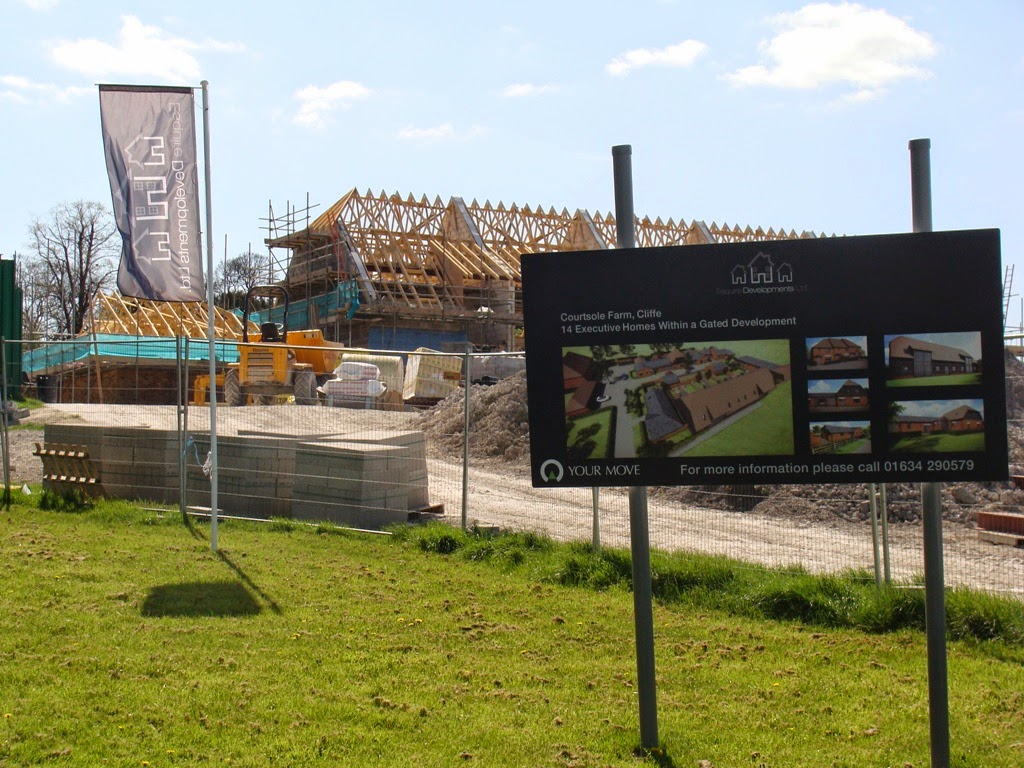
Now the second photo. I haven't walked down the track between the reserve and Cliffe village for a while, maybe since the winter. So I was surprised and  disappointed to see the old Courtshole Farm complex being developed, particularly sited as it is, just several hundred metres from the reserve boundary. Admittedly, I'd heard something was happening to it and it was in disrepair and largely only used for holding cattle in winter (as far I could tell?) but still...a shame. OK, so maybe they're converting it into flats or affordable homes for the kids who are growing up here I thought...ha, wrong! That sign reads "14 Executive Homes within a Gated Development". My stomach turned when I read that. Just what is an 'executive home' exactly? And WHY does a small, rural community in North Kent need an exclusive 'gated development' just yards from a SSSI boundary and historic church? In what reality...

So you see, I guess I was a bit distracted and I haven't even told you about the dirt biker or the people traipsing through a private field, toddler in tow, frightening all the livestock. I said there was a dark side in this post didn't I?
"Patience you must have" 
This aside, it was actually a pretty nice couple of hours at Cliffe in the sunshine. A single sub-adult Spoonbill was still present on Flamingo, while a couple of swallows and a single House Martin passed through headed north. Shoveler and Black-tailed godwits were still present in good number and at least three Sedge warblers were back on territory around Black Barns. Best of all though, were three nightingales singing loudly along the Saxon Shore Way. Always hidden, even when standing seemingly yards from them, it's great to have them back again.

Sitting out on the wall by the concrete coffins for a bit, several Mediterranean gulls drifted up river close in, cawing softly all the way. I love hearing the calls of these birds - instantly conjuring up thoughts of warm hazy days, just like their name. There were no terns to be seen but a single Harbour Porpoise was a bonus as it surfaced several times a short way off and headed down river towards the estuary. Topping off an eventful afternoon was a Black Swan on the pool at coastguard's, I had to do a double-take (!):

Mega: a totally genuine Black Swan (Cygnus atratus) Cliffe Pools, 13/4/14

After a shaky start, I think you'd agree there's plenty of reasons here not to let the dark side win...


Sunday, 23 February 2014

Spring, almost

A mirage of waders, Cliffe Pools RSPB 21/2/14

What a breath of fresh air the last few days have been, blue skies and sunshine hugging the horizon in this little part of England at least. Filled with the kind of dizzy spirit that only the end of winter can bring, I had an enjoyable few hours at Cliffe the other afternoon. Straight away the first signs of change were visible on the pool near the car park, where a small group of Black-headed gulls fussed and called on their breeding islands. In amongst them were three Oystercatchers no doubt with the same idea. On Radar pool the action was firmly packed around the causeways where a huge flock of wintering Black-tailed godwits continues their stay. Roosting nervously, the flock frequently took to the air as a dark Marsh Harrier loafed around the vicinity, however I soon spotted a more likely cause for alarm as a Peregrine patrolled distantly and passed right over my viewpoint. A good number of Pintail were visible on the pools and Gadwall too, surprisingly.

The bright, clear skies seemed perfect for Buzzards and it wasn't long before two appeared over the reserve. Hearing a distant mewing cry, I scanned and picked out one thermalling in high over the Cement works and another near Cliffe village. At the Thames Viewpoint the river was ablaze in harsh, late afternoon light and buffeted by increasing gusts of wind but on the more sheltered marsh eight Corn buntings (and likely as many more) showed well on a clump of brambles. It's always great to see these birds that blend so well into the drab colours of winter but whose rattling songs are too rarely heard here in spring.

Elsewhere a few Fieldfares lingered still on the skeletons of fruitless hawthorns and a Stock Dove flushed from the grass on the back track. The final spectacle of the day emerged over Cliffe Marshes in the distance where a large, sweeping flock of starlings, many thousands strong, stirred restlessly. It was the most I've seen in the area for some time.

Black-tailed Godwits (Limosa limosa) spooked by a passing Marsh Harrier
Green Woodpecker (Picus viridis) on the fence by Black Barns

Staying local, yesterday I made my Medway WeBS count from Hoo and Kingsnorth. Conditions were good, although the glare of the sun over the estuary made things difficult at times. The highlight was undoubtedly a large flock of Brent Geese which topped out at 531 after birds roosting on the marsh were flushed off during my count by a dog walker. A single Egyptian goose was in with them and a couple of Canada's but I couldn't detect any pale-breasted birds in the poor light. Otherwise the Teal flock remained steady at 170 birds while 186 Shelduck, 92 Oystercatcher and 5 Great Crested Grebes were also present. The most unusual encounter of the morning though was a single Dunlin which flushed out just yards ahead of me on the sea wall, I'm not used to seeing them so close. Other birds in the area included numerous skylarks and a flock of c130 Woodpigeon. At Kingsnorth Power Station a juvenile Marsh Harrier was being mobbed by rooks and the escaped Harris Hawk was still present in the paddocks  by the sewage farm. 

The final part of my count area is adjacent a small pocket of woodland that creeps right down the water's edge. It looks dense, diverse and largely untouched but a big 'Private' sign prevents me from exploring further. I don't like signs like this and I'm equally confused that the wood appears to be owned by a 'Residential Marine Ltd'. Maybe I'm just paranoid...


Thursday, 30 January 2014

A familiar pair of legs

It seems that celebrities were all over Hoo Peninsular at the weekend. I made a quick visit to Cliffe on Saturday afternoon and was pleased to bump into one of its own:

C-ringed Greenshank, Cliffe Pools, 25/1/14

This colour-ringed Greenshank (Tringa nebularia) pictured on the left, was roosting with a small flock of birds at the top of Flamingo pool. That in itself was good to see but with a closer look I spotted the rings and recognised the colour combination - it was a familiar pair of legs. You might just be able to make out the small Green over Orange flags on its left tarsus.

I saw this bird twice last year, when, with the help of another local birder, I was given the ringers details. He was quickly able to confirm that this bird is something of a Cliffe Pools stalwart as it has been returning to Cliffe every winter since 2006. Ringed locally in August 2006, this individual often stays in the area until April before reappearing again in late summer or autumn. Where it goes in the meantime is a guess, presumably it migrates to a breeding site much further north. On its travels it has also made brief stops in Buckinghamshire and Cambridgeshire, but it is its remarkable site fidelity here that makes it a special bird indeed and shows that it clearly finds conditions to its liking. I was really happy to see it back again for another year.

Saturday, 16 November 2013

A short walk

I took a short walk today. A lap of Cliffe, then home for the rugby, that was the plan.

The trouble is it was just one of those autumn days you never want to end. It was both crisp and mild, with barely more than jet trails to spoil the blue sky. It sucked me in hopelessly 'til I lost track of time. It was gone dusk when I got back home.

Cliffe was heaving with birds. On Radar I found my first Goldeneyes of the winter, a handful of handsome males with a couple of females. Wigeon, shoveler, teal and grebes were all present in high numbers. Checking the causeways with the recent Glossy Ibis in mind turned up a Greenshank in with the reds. Along the Saxon Shore Way, a Brambling flew over and a male Blackcap caught the morning sun perched among some rosehips. As I was walking along to Flamingo I spotted a couple of swans out on the pool that I'd seen sleeping way back from Radar. Closer in I could see they were awake now and sporting nice 'stiff' necks with yellow around their bills. Finding a better view of the birds, I could see the small extent of yellow did not reach the nostrils which confirmed I had a cracking pair of Bewick's Swans. It was an unexpected treat and a new site tick for me.

Bewick's Swans (Cygnus columbianus), Cliffe Pools, 16/11/13
The shifting shapes of thousands of waders
Coots (Fulica atra): always overlooked, never outnumbered

From being pretty quiet a couple of weeks ago, Flamingo pool was full to the brim this morning. Not only has the current dredging campaign pushed water levels right up, seemingly attracting more wildfowl in the process but it has increased the bank of mud on the far side. I only needed one look at the thousands of Dunlin spiralling and twisting over the pools to see it was high tide on the river. The birds put on a stunning show and I spent quite a bit of time just watching them jostle about on the mud before taking off again. Their restlessness seemed to distract the Bewick's who pitched up and flew off high to the east. Everything was restless it seemed, fleeting appearances from a young Marsh Harrier hardly helped but a Peregrine coursing the skies was the more likely culprit.

I'm not sure why I decided to follow the seawall out to the 'coffins', but I'm glad I did. Some way along, past Lower Hope Point, a single Snow Bunting popped up without calling and landed no more than ten metres from me. It even had the decency to allow me to take some crap photos before darting off.  

Snow Bunting (Plectrophenax nivalis), adult male on rocks at Lower Hope Point, Hoo Pen.
The changing horizon at Cliffe Pools
One of the dredging tugs on the river at Cliffe, not sinking apparently.

I love this stretch of the river but it struck me how quickly its landscape is changing. As I walked another few miles east without seeing another person, the only sound I heard the whole time, aside from the calls of birds, was a distant, endless clanging and whirring from the vast Thames Gateway port on the other side of the river. I ended up missing the Richard's Pipit at Egypt Bay (a great find by Paul Hawkins - here) although I gave it a quick go. A noisy Water Rail, a Bearded Tit and two Green Sandpipers were present but the light was disappearing rapidly as it does these afternoons and I didn't fancy walking those miles back in the dark. So I re-traced my steps along the wall as the light went from orange to pink, ending with a greyness that smudged the marshes and the velvety ooze of the river.

Some way along a small flock of Redwing flew over tseep-ing in the dusk and a bolting Pheasant nearly gave me a heart attack. But a great day out was sealed by a small raptor coming off the sea wall ahead, although only a silhouette, its size suggested a Merlin that was heading back to roost.


Saturday, 28 September 2013

Lesser Yellowlegs at Cliffe

Lesser Yellowlegs (Tringa flavipes) RSPB Cliffe Pools, 27/9/13

I finally caught up with Cliffe's Lesser Yellowlegs yesterday evening, at the third attempt. Having first ventured out during the peasouper on Tuesday morning, only to find two other birders staring at a thick wall of fog, and managing a frustratingly brief view late on Thursday evening, yesterday it showed well on the second Black Barn pool until around 18.20 when presumably it went to roost.

This bird was a first for me and I was surprised to note just how 'dainty' it was compared to the few Redshanks that were around. The combination of slender yellow legs, fine, dark bill (which I have read described as being approximately equal to its 'head length') and particularly its visibly sharp, attenuated rear end, were all good features in the field where the light was otherwise pretty weak. The number of Ruff on the pool, that ever shape-shifting wader, kept things interesting, the variability of that species amazes me. Still, the american wader was the star of the show, ably supported by the seasonal fare of passage birds, the first Wigeon flocks of autumn and a Barn Owl that hunted with typical grace over the causeways on Thursday.


Monday, 22 July 2013

Arctic arrivals at Cliffe

Mud: they love it, you love it. Cliffe Pools, 21/7/13

Despite earning some unfortunate tshirt tan lines on a sweltering walk round Cliffe yesterday, there were hints of cooler climes with a smattering of new arrivals from their northern breeding grounds. A nice summer plumaged Knot bobbing amongst the common terns on islands at the back of Conoco had me thinking Curlew Sandpiper for a moment but a better look confirmed otherwise. I like this time of year, having to get wader brain on again, ready for those birds in summer dress or moult, usually more conspicuous here in their muted tones of winter.

On Flamingo beach a good flock of 16 Whimbrel roosted amidst the sea of Shelduck that have been busy at Cliffe this season. Over the Thames Viewpoint, five juveniles took one of their first trips out, accompanied by an adult. The river was flat calm, seemingly stuck to the sky, with a faint easterly as comforting as a stranger's hot breath on your neck on a rush-hour tube.

Down the back track two Yellow wagtails flew over and instantly disappeared into the coarse, bleached rough of the coastguard paddocks. Two Pied wagtails sparred energetically. I love this part of the reserve, the view is one of Hoo's best, several miles of marshes and grassland stretching east, pocked with livestock, ditches and forgotten barns, parched in this heat but still buzzing:

View east from Cliffe Pools, 21/7/13

If Boris and those other soulless crones had their way, everything in the photo above, bar a thin sliver in the foreground, would be tarmac and fences.

Seven Oystercatchers on the jetty, two adult Common gulls looked hot.

I spent a while by Black Barns 1 & 2 but despite some muddy fringes appearing, the levels on the pools are still too high for most waders. A handful of hazy shapes on 4 could be picked out by squinting and refocusing; one or two Greenshank among godwits and lapwings. One or two eclipse Shoveler lurked in the reeds too and a healthy brood of Tufted ducks formed a queue behind their parents. In the top corner of Radar, a gathering of 12 roosting Greenshank were punctuated by a single small wader which turned out to be a nice summer Sanderling. I can't remember the last time I saw one so neat. A Green Sandpiper flew over and several Little egrets probed and preened in the shallows - making it look like a good day to be an egret.

Round at the Radar viewpoint I bumped into a birder who put me onto a Turnstone, another bird I associate more with winter on the estuary than anything. A large flock of brick-red Black-tailed godwits roosted on one the main causeway, alongside Redshank, Lapwing, Greylag geese and more Greenshank. As an annoying microlight flew low over the reserve, the whole lot pitched up and wheeled about, revealing the huge, previously hidden flock of Avocet behind. With the numbers present it was like an unseasonal snowstorm had descended, only to melt away in a flash.

The final wader action came in the form of several Dunlin on Radar, while a check along the rear of the causeway from the Saxon Shore Way eventually turned up a Spotted Redshank. This one wasn't quite suited up so was perhaps a non-breeder, still, a nice looking bird. A pretty good haul, things are hotting up...


Six-spot Burnet on Ragwort
Comma on brambles
No Estuary Airport

Monday, 3 June 2013

Cuckoo for Cliffe

I had planned to go the badger demo at Millbank on Saturday morning but as it was, when Saturday morning rolled around the last place I wanted to be was central London. I spend enough time there. I think it's great that it went ahead, also that we remember how things used to be before 38 Degrees came along; friends tell me it was fun and 'the vibe' was positive so that's all good. But if I was there in spirit, my body was 30 odd miles down river, drifting around Cliffe Pools.

There's no doubt that Black-headed gulls are ruling the roost at Cliffe this spring and the noise and commotion across the causeways is really something. Numbers certainly look higher than the last 2 years at least, somewhere north of 600 individuals perhaps. There were a good few chicks on show already. In among them, Avocets are conspicuous with a lot of calling, general aggro and a couple of fledglings already learning the ropes on the mud. The other noisy neighbours are the Common terns, again in strong numbers (c50 pairs) on the radar islands. Throw in a couple of Mediterranean gulls and it's a pretty amazing sight at the moment.

Further round, Allen's pond was fizzing with activity too. Best of the lot was a Nightingale behaving like a Spotted Flycatcher, continually darting out from the cover of a Buddleia with a flash of its reddish tail. In fact, all the birds were at it - Robin, Chaffinch, Chiffchaff, Whitethroat, a female Blackcap looked like she'd bitten off more than she could handle with a damselfly though. The only thing missing from this party was a Spotted Flycatcher behaving like a Spotted Flycatcher.

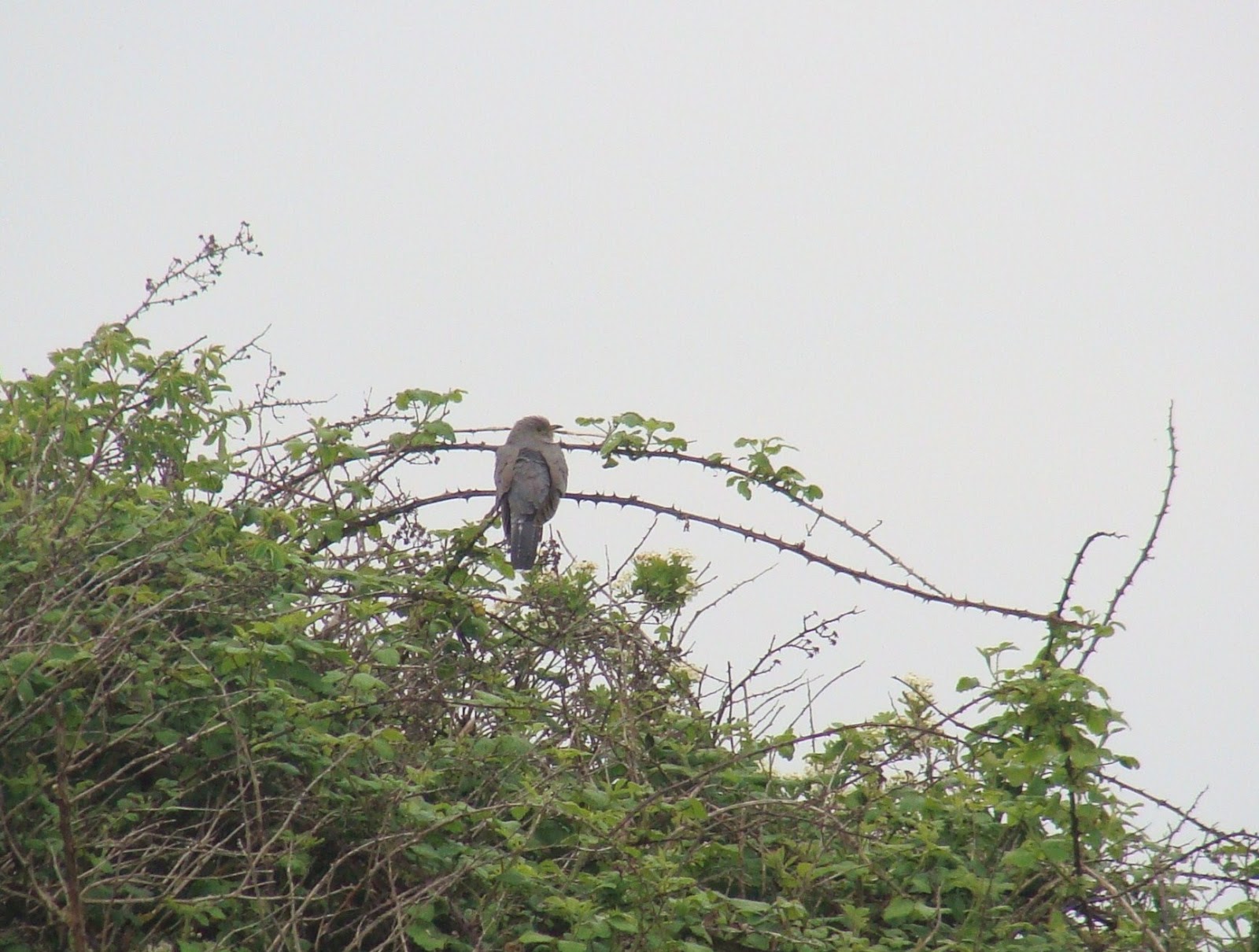
The highlight of the afternoon though was probably this Cuckoo perching happily on brambles along the track by the Black Barn viewpoints:


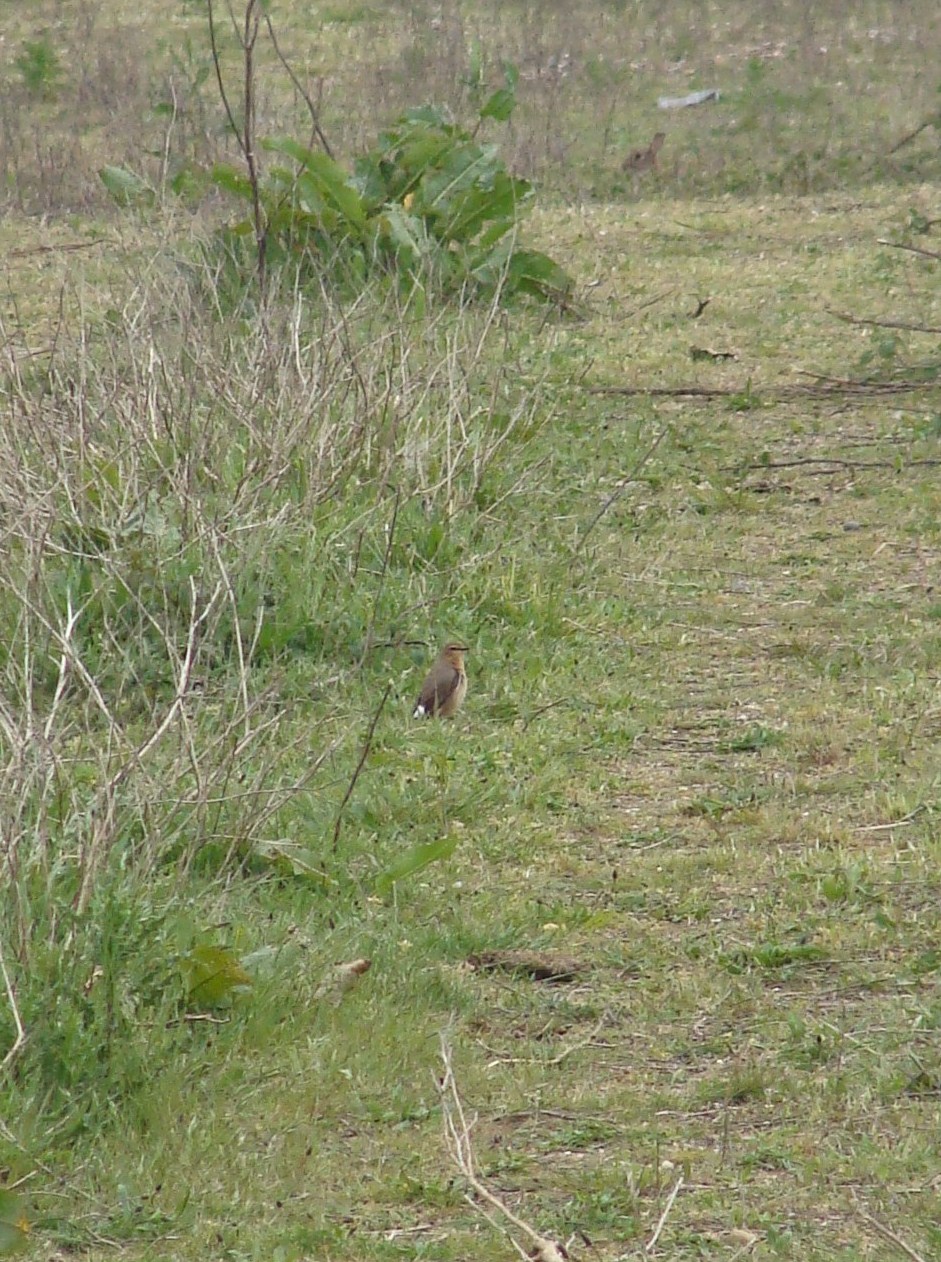
This was one of at least three birds present, with two more together in scrub briefly near the Thames VP  - one of which flew straight across in front of me, over the sea wall and presumably across the river to Tilbury. There was one more nice surprise, this female Wheatear lurking in the grass along the no entry track:

Get a move on love..! 

Between tides and the mid-afternoon lull, it was a pretty good couple of hours really. And thankfully nothing like central London.

Which way to Millbank?

Monday, 24 December 2012

In the bleak mid-winter: Cliffe Pools 24/12/12

With mum feverishly decking the halls to the accompaniment of dubious Christmas music, I decided to duck out and head to Cliffe Pools for a few hours today. Weather-wise it was a Cliffe kinda day, sultrily overcast, a light breeze and rain not too far away, but I went anyway.

There are a LOT of birds at Cliffe at the moment and while I found nothing that might be considered an early Christmas present, it's never a case of quantity over quality here. The sheer number of ducks and waders on the pools was quite something: tufteds, mallards, little grebes and coots gathered in the hundreds, with pintails, shovelers and gadwalls not far behind. Several handsome drake goldeneyes stood out too, one male jerking his head up and down before behaving in a rather unfestive-like manner with his female companion. But these were nothing compared to the lapwings and black-tailed godwits blanketing the causeways. Their true numbers were only given away when they were spooked by something unseen; there must have been comfortably 1500 of each, swooping and swirling in the dreary afternoon light. It was spectacular:


Heading up the track, the site was quieter; a Kingfisher zipped by and a Curlew called somewhere in the grey and sodden fields, Black-headed gulls and several distant scoters made slow progress in the headwind on the river, but otherwise it almost seemed that all through the site, nothing was stirring, not even a, well y'know...


Have a great Christmas everyone, thanks for reading.